

On this page3 sections
CloudWatch Omni brings service discovery, agent evaluations, traces and natural-language queries into a shared working interface. For an SRE investigating a failed agent request, that can shorten the trip from the agent’s activity to the service behind it. The account and Region containing each record still matter: a trace in one space may need to be connected with service logs in another.
AWS announced general availability on September 23, 2026, initially in US East (N. Virginia), US West (Oregon) and Europe (Ireland). It offers a standalone web experience with single sign-on (SSO) and an extension for VS Code, Cursor and Kiro. AWS says local agent development through the extension does not require an AWS account. These are useful entry points; the location of operational evidence still determines what each investigation can establish.
How domains, spaces and telemetry scope fit together
The Omni documentation calls the entry point and identity connection a domain; its spaces are associated with an account and Region. Omni does not independently centralize telemetry between accounts or Regions. That depends on CloudWatch centralization rules, so shared sign-in can leave a downstream service’s records outside the selected space.
Existing CloudWatch telemetry remains usable, and the established console, alarms and APIs remain in place. Omni brings traces, latency and token usage into the workspace. These are documented capabilities, rather than a measured reduction in incident-resolution time.
Follow the missing order lookup to its destination
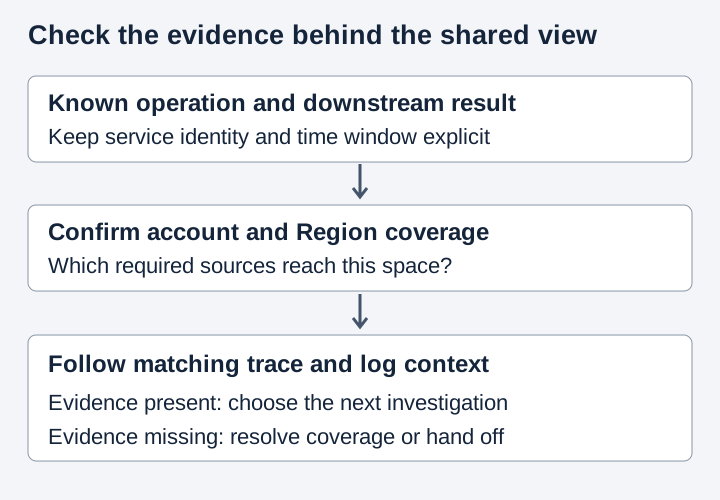
Consider a hypothetical agent reporting that an order lookup failed. Its spans reached the selected space, but the order service operates in another account whose telemetry did not. The empty query cannot establish that the service never received the request. Before changing the agent or repeating consequential work, inspect the destination through an authorized path.
Test one synthetic operation with a known downstream result, following its identifiers through traces and logs to the same service and time window. Then deliberately omit one telemetry source and see whether the responder recognizes the gap and chooses the next check. This applies the continuity principle from our OpenTelemetry explanation to Omni’s actual account and Region boundaries.
When policy prevents centralizing a source, keep a documented distributed investigation. For this lookup, identify the person allowed to inspect the other account and the request ID they need. Reliable access to that check can satisfy the investigation without moving every record into one space or broadening permissions.
The investigation benefit and its running cost
AWS lists separate ingestion, storage and analysis charges, while agent evaluations use AgentCore Evaluations rates. Compare those costs with the existing investigation path. If the pilot makes a specific decision easier, exposes unavailable evidence and leaves a dependable way to retrieve it, the team can judge whether maintaining that improvement is worthwhile. For the order lookup, the benefit is a shorter path from the agent’s failed call to the downstream service record that explains it.
Sources & context
Sources linked in this article. Read alongside the author’s analysis; a citation does not independently verify a publisher’s claims.
- announced general availability on September 23, 2026aws.amazon.com
- Omni documentationdocs.aws.amazon.com
- AWS lists separate ingestion, storage and analysis chargesaws.amazon.com