

On this page5 sections
An incident investigation can leave an engineer moving between a deployment diff, a long log export, traces, a runbook and several hours of discussion. Each source contains part of the explanation. The work is in finding the relationships, including the awkward detail that makes the most convenient explanation fall apart.
Kimi K3 offers more room to keep that material together. Moonshot AI announced the model on July 17, 2026, then released its weights and technical report on July 27. Its million-token context and native visual understanding make it an interesting candidate for reviewing a large incident record alongside dashboard images. Whether it helps an on-call team depends on what survives in the answer: source references, competing explanations and a useful next check.
This is a source-based assessment, with an illustrative investigation below. It does not report a hands-on K3 deployment or a measured improvement in incident response.
What fits in the context
The official model card lists a 1,048,576-token context window, 2.8 trillion total parameters and 104 billion activated parameters. Tokens are the pieces of input and output a language model processes. The context window limits how much of that material can be available in a request; the parameter counts describe the model itself. K3 uses a mixture-of-experts design, selecting part of the network for each token. A larger input allowance gives the investigation more room, but says nothing by itself about which clue the answer will notice.
More room can save you from compressing away the very detail the investigation needs. It does not organize the packet for you. A timestamp must still say whether it records the event or the collection; a runbook must still carry its version. Repeating a log line a thousand times makes the input longer without making the clue stronger. Assemble the larger context so the model can connect observations that a responder could also trace.
The useful comparison is therefore between ways of supplying the same investigation. One can use a larger source packet; another can retrieve a smaller set of relevant passages. Compare which answer preserves the evidence needed to choose the next step, along with the time and cost of producing it. If a shorter packet preserves the same decisive observations, the extra input has not improved this investigation.
Reading the incident in time order
Consider a hypothetical checkout service. The new application version first serves traffic at 09:10, and the customer-error alert fires at 09:12. The incident channel quickly settles on rollback. Elsewhere in the packet, payment-provider timeouts begin at 09:06, while an unaffected request path uses the same new application version. These are invented times and observations for an evaluation case, not a reported outage.
A useful K3 response would keep these observations visible. The alert time explains when the rule fired; the earlier timeouts challenge the claim that the deployment started it. The unaffected path offers a comparison, although it cannot by itself clear the deployment. The next query could separate requests that reached the payment provider from those that did not, and compare both groups before and after the release.
Our approach to AI-assisted observability evaluates a summary by the investigation it enables. Applied here, a long-context answer earns its value by retaining the 09:06 evidence and explaining which query could distinguish the competing causes. A polished rollback recommendation that omits that evidence gives the responder less to work with, even if it correctly quotes most of the packet.
Run the checkout question twice with the same K3 settings: once with the larger assembled record and once with retrieved excerpts. Then look for the 09:06 entry in what the model actually received, before judging its answer. If retrieval left that line out, the model never had the chance to notice it. If both inputs contain it but only one answer uses it, you have learned something different about the workflow.
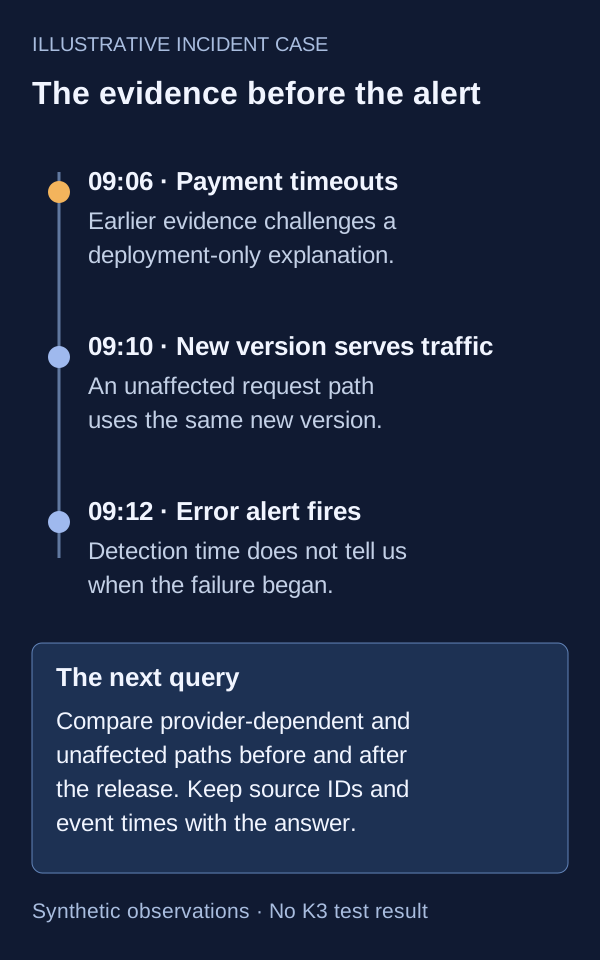
In the replay, ask the reviewer two separate questions: did the answer retain the earlier timeouts, and would its proposed query distinguish the payment path from the release? An elegant explanation can fail the first; a correct quotation can fail the second. Hide the known outcome, retain the contradictory observations, and record invented facts or lost uncertainty as failures. Elapsed time, tool calls and billed tokens complete the cost side of that comparison. These are criteria for a trial, not results already established by the announcement.
A million-token window cannot supply a timestamp nobody recorded. If the packet cannot distinguish the affected request paths, more reading will not resolve the cause. The useful response is to name that missing observation and suggest how to obtain it. Conversely, when a small retrieved packet preserves the decisive facts, reading the whole archive may buy little beyond a larger bill.
Keeping an agent session intact
Using K3 in a multi-turn incident assistant also depends on how the application preserves the conversation. Moonshot's usage instructions say subsequent turns should preserve the complete assistant message, including reasoning_content and tool_calls. A wrapper that strips these fields before returning tool results can change the session the model was trained to use. Current API documentation supports low, high and max reasoning effort, with max as the default; the launch article's promise of later low/high support is no longer the current configuration.
Moonshot also warns that K3 may make unexpected decisions when a task is ambiguous, and that switching an ongoing conversation from another model can destabilize the context. For an incident assistant, explicit instructions should distinguish reading telemetry, proposing a mitigation and executing it. The tool layer should enforce that distinction: a read-only investigation account needs no deployment-write permission.
If a later workflow can perform a rollback, the bounded-action approach applies to the actual deployment and its current version. Approval for one proposed change should not silently cover a different target or a state that has changed since review. The capability to keep working through a long task makes that execution detail more consequential.
The API bill and the self-hosting bill
As checked on October 5, the official USD pricing is $3 per million uncached input tokens and $15 per million output tokens. Cache accounting adds an important distinction: five-minute cache writes cost $3 per million tokens, one-hour writes cost $6, and cache reads cost $0.30. Uncached input, writes and reads are separate input categories; do not charge the same token once as uncached input and again as a cache write.
For a deliberately simple illustration, a request with one million uncached input tokens and 10,000 output tokens costs $3.15 at those rates, excluding tax. If the same million-token prefix is subsequently billed entirely as cache reads, with another 10,000 output tokens, that request costs $0.45. These are arithmetic examples, not measured incident workloads. Added evidence, reasoning output, tool rounds and expired or mismatched prefixes change the bill. A large packet repeated across several turns can make caching valuable, but the actual usage counters have to establish the saving.
Self-hosting replaces that API calculation with capacity, networking and operations work. Moonshot's architecture discussion recommends supernodes of 64 or more accelerators for efficient deployment. That is a recommendation rather than a hard minimum: the current vLLM recipe documents configurations starting at eight GB300 or eight MI355X/MI350X accelerators, and points to multi-node deployment for production traffic. Those are documented serving configurations, not throughput or availability measurements reproduced for this article.
Access to the weights gives a team another deployment option, but the license needs its own review. The custom Kimi K3 License permits commercial use subject to conditions. Among them, a qualifying model-as-a-service business whose combined licensee-and-affiliate revenue exceeds $20 million in any consecutive 12 months needs a separate agreement, and very large commercial products have attribution obligations. Defined internal use and official or certified-partner services have exemptions from specified clauses. Open-weight describes the availability more carefully than calling the model unrestricted open-source; the exact service and business arrangement determine which terms matter.
What the benchmarks leave open
Moonshot's technical report describes strong results across reasoning, coding and agent tasks, with evaluation conditions that deserve to travel with the scores. Its BrowseComp result with compaction at 300,000 tokens differs from the full-million-token run without context management. Other comparisons include hardware or harness adaptations. These are vendor-reported evaluations of particular setups, rather than an independent test of incident diagnosis or permission handling.
The promising use for K3 is an investigation that keeps losing its useful exceptions in summaries and handoffs. In the checkout example, the important detail is a small one: the payment timeouts started at 09:06, before the release. Keeping that line beside the deployment record opens a better question than “Should we roll back?” The large window provides room for the clue; the trial has to show that the answer notices it and helps a responder act on it.
Source context
Source links appear within this article. Read them alongside the author’s analysis and evaluate the guidance against your environment.
Report an error or outdated detail