

On this page3 sections
A warning such as “Possible XSS in search” gives a product engineer a new investigation, not yet a reproducible bug. They still need the input, affected page and browser behavior. Google’s PageBreak project puts a separate validation step between an AI agent’s candidate and the report that interrupts the receiving team, aiming to do that reconstruction before asking the team to act.
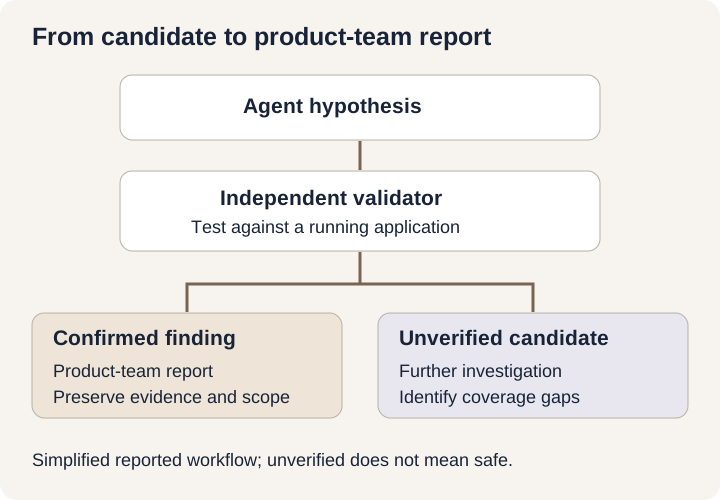
Google described the internal project on September 24, 2026. PageBreak is internal rather than a publicly available scanner. Its agent proposes vulnerabilities, while validators written without AI test those candidates against running applications. The distinction matters because a persuasive explanation and a demonstrated failure are different outputs.
The report follows an observed browser result
Cross-site scripting, XSS, lets attacker-controlled content execute as JavaScript in another person’s browser. For a candidate of this kind, PageBreak’s validator inserts a test payload and renders the URL through Google’s scanning infrastructure, then checks whether the script executed. A report can consequently point to observed behavior rather than only the agent’s judgment that some code looks vulnerable.
Google reports more than 500 XSS findings with a near-zero false-positive rate; these are the company’s own results. Confirmed findings go to product teams. Unverified candidates are retained for investigation and validation improvements, preserving the distinction between “not established” and “not present.”
The reproduction becomes the first test of the fix
Consider a hypothetical search-page report containing the tested URL and version, input and observed browser behavior. Those details give the developer a starting case to reproduce; once the defect is understood, the same case can check the repair. The alert-trust principle puts the burden on the interruption to support progress. Here, that means supplying the demonstrated failure before asking the developer to investigate, rather than sending a bare warning or a long narrative whose central claim cannot be reproduced.
The test’s stopping point matters too. If the validator never passes sign-in, it has not examined the suspected flaw on the search page. A security reviewer should investigate that access gap before closing an important customer-facing candidate. Recording the failed step prevents the next investigator from repeating the same incomplete scan without learning why it failed.
Verified findings still enter a repair queue
Google says the volume of validated reports creates its own challenge for product teams. PageBreak benefits from existing repository and authenticated scanning infrastructure, while incomplete validators can still miss vulnerabilities. Increasing discovery therefore changes both the amount of work arriving and the coverage questions left open.
For a local trial of a similar agent-and-validator workflow, use one application with developers available to reproduce and repair its findings. Follow each report through the tested case, clarification needed and fix check, recording the investigation effort as well as work still waiting for repair. That record can reveal whether validation reduces reconstruction or mainly adds confirmed bugs to a queue the team cannot clear. Important pages the validator cannot reach still need manual review, so keep that uncovered work in the same account.
Sources & context
Sources linked in this article. Read alongside the author’s analysis; a citation does not independently verify a publisher’s claims.
- described PageBreak on September 24, 2026blog.google