

On this page3 sections
Google lists Nano Banana 2.1 as generally available from October 6, 2026, under the model ID gemini-nano-banana-2.1. It generates and edits images, but setting seed, topK, logprobs, temperature or topP returns an API error. Google's model documentation
That is a small list with a practical consequence for an existing image service. A shared client can attach generation settings after the application has assembled its prompt. Changing the model name may leave those settings intact, producing a request the new model cannot accept. The service's worker can remain healthy while thumbnail jobs fail to produce a file.
The useful migration check therefore starts with the request the application actually sends and ends with the image it delivers. Following that path also tells an engineer whether a failed job needs a corrected configuration or another attempt.
A shared default can become an incompatible field
Consider a hypothetical thumbnail service. An editor submits a product brief, a queue gives the job to a worker, and the worker turns the brief into an image prompt. Its shared generation helper attaches a temperature setting to every model request. An engineer updates the model selection but leaves the helper alone. In this design, the outgoing request still contains the unsupported field, so generation returns an error instead of a thumbnail. This is an illustrative integration failure, not a test or incident observed for this article.
The prompt itself may be perfectly reasonable. The mismatch lies in the surrounding request: the fields that tell the API how the application wants generation performed. This distinction matters because changing the prompt cannot remove a setting inserted later by the helper. Nor will a queue retry remove it. The same job reaches the same code and acquires the same field again.
Inspect the serialized request after application defaults and middleware have been applied, with credentials and private prompt content excluded from diagnostic records. Comparing that request with the model's documented capabilities exposes a problem a prompt-only test would miss. Keep the model ID and the application's configuration version with the error so a responder can locate the code that assembled it.
A model-specific adapter can construct the permitted configuration while the queue and storage workflow remain familiar. The useful part is an explicit choice about what to send, rather than copying every setting from a common configuration object. A small adapter also gives future changes a place to be reviewed without scattering model checks throughout the service.
Some settings express a requirement, however. If a caller depends on a seed-based control for its evaluation workflow, silently removing that field changes what the application promises. The migration then needs another acceptable evaluation method or a model that supports the required control. Making the request acceptable cannot establish that the original requirement has been met.
The returned error determines the next attempt
Request incompatibility and scarce capacity require different responses. Google's general error guide associates 400 with validation or precondition failures, including access-policy issues, and 429 with resource exhaustion such as quota or shared capacity. The model page does not specify the exact code returned for each rejected field. Google's API error guide
For the thumbnail worker, record the actual status and message before choosing a response. When they establish that the configuration is invalid, another identical request leaves the cause untouched. Keep the job in a failed state that the application can explain, correct the adapter, and resubmit under the corrected configuration. A temporary capacity response may justify a bounded retry with backoff, while preserving the editor's deadline and the job's identity.
The retry path belongs in the compatibility check because it can amplify a small migration mistake. A worker that promptly retries every failure can spend its time making requests that will never succeed under that configuration. Recording attempts separately from completed thumbnail jobs makes that wasted work visible without confusing it with useful throughput.
There is also a capability check above individual fields. Google's page lists structured output, function calling and Chat Completions as unsupported. A wrapper that requires one of those features needs a supported integration path; removing a sampling setting alone cannot supply it. This is a limit on this model's interface, not a restriction on the surrounding application's own queue, tools or storage code. Model capabilities
Follow the job through to a usable thumbnail
After the request is corrected, the migration still needs a result that can challenge its success claim. Our feedback-loop approach compares a change with an independent customer or workload signal, so an improvement cannot be created by hiding demand. For this service, keep submitted thumbnail jobs visible and check whether their output files can actually be retrieved. Excluding rejected jobs from the comparison would make the new path look healthier without giving those editors an image.
The worker's API record and the application's delivery record answer different questions. The first shows whether generation returned a result. The second can show whether the image passed the service's file checks, reached storage and became available at the editor's thumbnail URL. A request accepted by the queue reaches neither conclusion by itself. Keep these stages connected by the job identifier so a missing file leads to the failed step rather than another speculative model call.
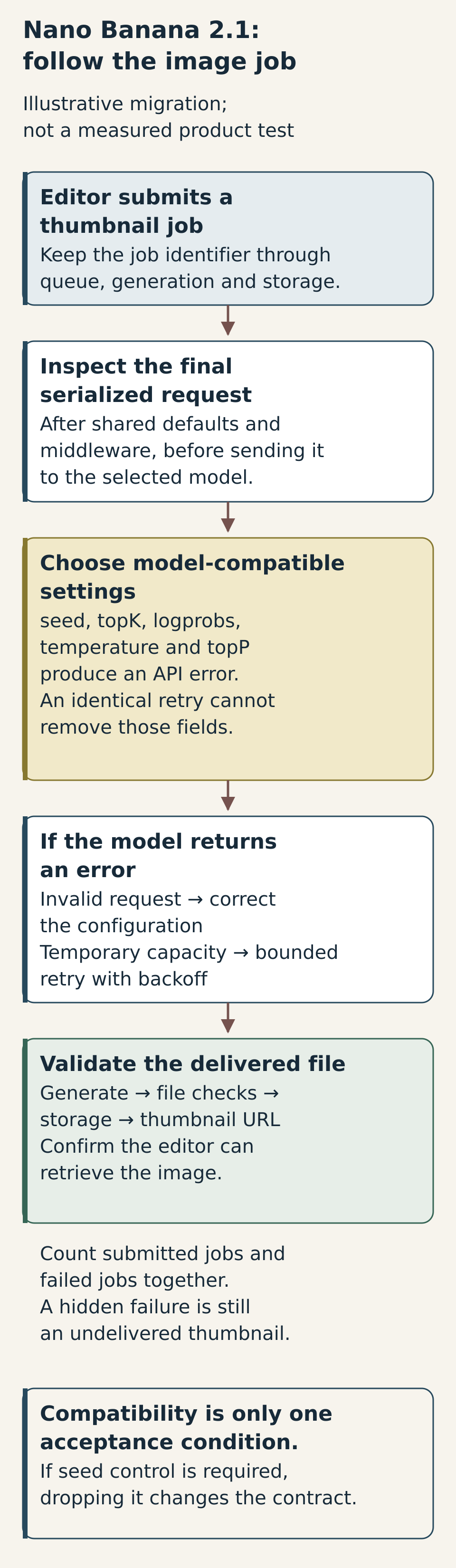
Read diagram description
Illustrative thumbnail service. Follow one job from its queue entry through the outgoing request, the generation attempt, file checks, storage and the editor's thumbnail URL. Carry the job identifier across those steps. It ends with retrieval and keeps failed jobs in the comparison. A control required by the application must be satisfied before the migration can meet that requirement.
For a small migration exercise, send representative thumbnail jobs through the same helper and delivery path the application will use. Preserve their final request configuration, errors, attempt counts and retrievable outputs. This does not require replacing the service's existing image-quality review: a file can be delivered correctly and still miss the product brief. Delivery checks and content review should retain their separate purposes.
Nano Banana 2.1's release gives an image service a new candidate to evaluate. The thumbnail example shows what a meaningful first comparison would contain: requests assembled by the real application path, failures that remain visible, and images that reach the people who requested them. Those records let the team correct a wrapper incompatibility before expanding traffic and judge the migration by completed work.
Source context
Source links appear within this article. Read them alongside the author’s analysis and evaluate the guidance against your environment.
Report an error or outdated detail