

On this page5 sections
Meta introduced Muse Wonder and Muse Wonder Full on October 12 with two capabilities aimed at long-running agents. Active Memory is meant to carry relevant information across conversations. Active Focus is meant to keep working toward a goal, try another approach after an error, and ask before completing an important action.
Those claims describe something more demanding than a model answering a difficult prompt. The agent has to remember the right state, ignore stale or irrelevant details, recover without repeating a completed action, and show that the destination reached the intended condition. That changes how an operations team should evaluate the model.
Active Memory and Active Focus move evaluation from isolated answer quality to selective state, recovery behavior, and independently verified outcomes across time. Test the exact product surface with conflicting history, corrected state, uncertain tool outcomes, consequential ambiguity, and an external acceptance check.
A widely discussed r/singularity thread focused on benchmark comparisons and missing model details. The better production question is narrower: does the memory and recovery behavior remain correct across the exact workflow you plan to run?
Active Memory is selective state, not a larger transcript
Meta says Active Memory can carry what matters across conversations and retrieve details relevant to the current task. That description implies selection. A useful memory system must decide what to store, what to retrieve, and what to disregard when later evidence changes the record.
A test should therefore contain conflicts, corrections, and irrelevant history. If a user first says a maintenance window begins at 22:00 and later moves it to 23:30, the agent should use the revised time and retain enough provenance to explain why. Repeating both times into the next prompt is not successful memory. Neither is silently choosing one without exposing the conflict.
Meta has not published enough implementation detail in the announcement to establish the storage boundary, retention duration, or exact behavior across Muse, Muse Code, and the Model API. Treat Active Memory as a vendor capability claim and test the surface you will actually operate. Do not infer that memory available in one product automatically appears in another.
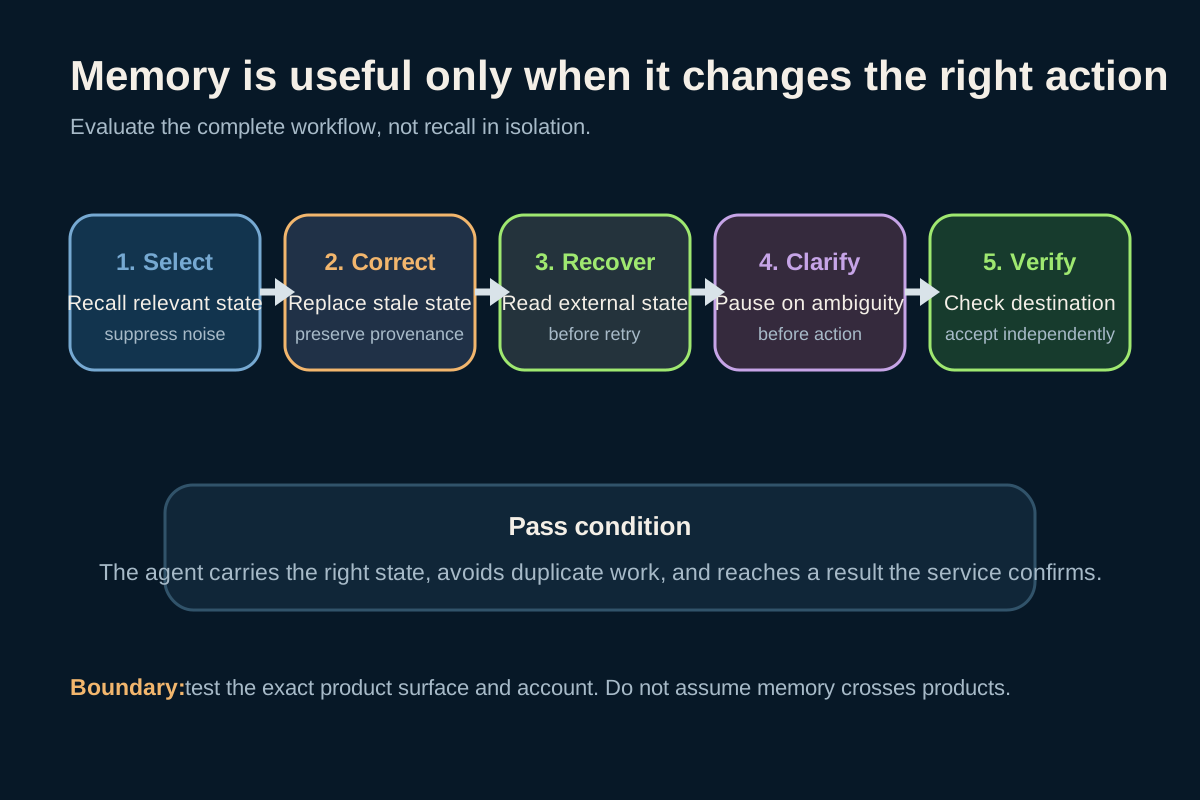
Active Focus turns errors into state transitions
Meta describes Active Focus as the ability to persist toward a goal, try other approaches, recover from errors, and check in before something important happens. Each behavior changes state. The evaluation should record the state before the error, the recovery decision, any external actions already completed, and the evidence used to continue.
The evaluation follows memory selection into corrected state, error recovery, clarification before action, and independent destination verification.
Consider a hypothetical agent preparing a software maintenance change. It reads the approved window, opens a change record, and calls a deployment tool. The stream disconnects after the tool call. A weak recovery starts the deployment again because the local transcript lacks a success message. A stronger recovery retrieves the change record and deployment state, discovers whether the action occurred, and continues only the unfinished work.
An agent's recovery claim must be checked against independent service evidence. The transcript can show what the model intended and which call it attempted. The deployment system, ticket, or customer-facing result shows what actually happened.
Five tests reveal different failure modes
Start with selective recall. Place several plausible but irrelevant facts in earlier conversations and verify that the agent retrieves only the facts needed for the present decision. Record both missed relevant details and irrelevant details that changed the answer.
Next, test correction. Change a previously stored value and ask the agent to act later. The expected result should include the new value and preserve enough source information to distinguish a correction from two equally valid options.
Then interrupt a tool call after the request may have reached the destination. The agent should reconcile state before retrying. This is where memory and recovery meet: it must remember the intended action without assuming the result.
Test clarification with a consequential ambiguity. If two production clusters have similar names, the agent should ask which target is intended before acting. Persistent focus is not the same as pressing ahead. A well-timed question is part of successful completion.
Finally, verify the result outside the agent. Read the destination, inspect the service, or run the consumer's acceptance check. A completed agent turn is evidence about the workflow, not proof of the external outcome.
Measure memory quality at the decision it changes
Recall accuracy is useful, but it is not enough. Track whether retrieved state changed the action correctly, whether stale state was suppressed, whether the agent requested clarification at the right boundary, and whether recovery avoided duplicate work. For workflows with sensitive context, also verify that irrelevant private information was not surfaced into a task that did not need it.
Meta says the Wonder family is trained to avoid sharing private information without permission and plans a fuller safety report. Until that report and product-specific controls are available, do not turn the announcement into a universal privacy claim. Evaluate access, retention, deletion, and disclosure behavior in the actual product and account boundary.
The nearest existing AIOpsSRE coverage asks how a benchmark separates a model from its harness. This article answers a different question. Once a long-running agent claims memory and recovery, which workflow evidence should determine whether those features are safe and useful?
What the release establishes today
Muse Wonder is available through the Meta Model API and Muse Code, while Wonder Full is available to Muse Code subscribers. Meta says Wonder will later power Muse, beginning with subscribers. Those availability statements are concrete. Claims that the models deliver state-of-the-art agent performance remain vendor results until independent evaluation reproduces them under a defined setup.
Active Memory and Active Focus are still important ideas because they name the hard parts of work that spans time. The operational test is not whether the model remembers something or keeps trying. It is whether it carries forward the right state, changes course when evidence changes, reconciles uncertain actions, and reaches a result the destination can independently confirm.
Source context
Source links appear within this article. Read them alongside the author’s analysis and evaluate the guidance against your environment.
Report an error or outdated detail