
On this page8 sections
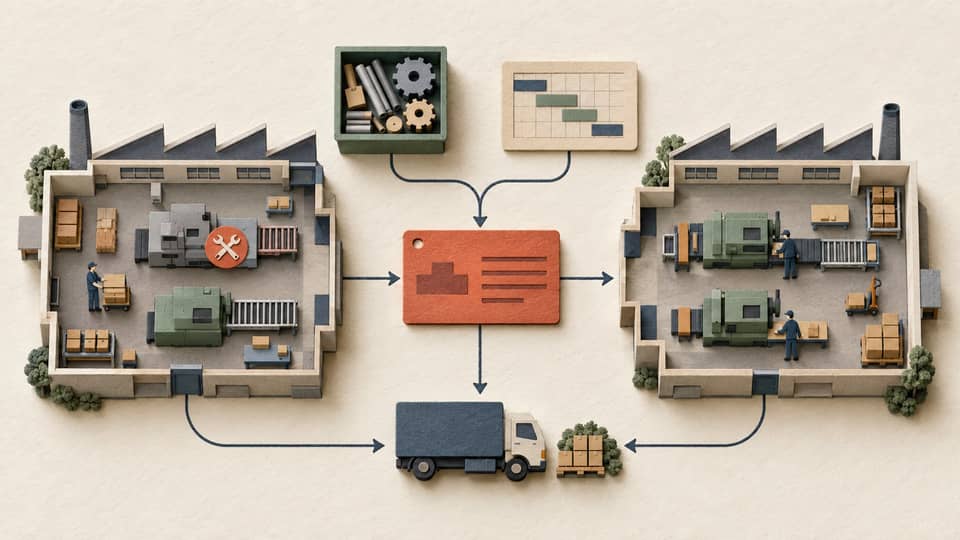
Friday’s order needs another factory. The planner can find spare machine time, but the parts list is in one system, the maintenance schedule in another and the transport booking somewhere else. Before anyone can decide, six people may have to explain their corner of the same order.
Palantir sells software for bringing those records together, building applications around them and carrying decisions into actions. Businesses and government organizations use its products. AI is part of the offering, but the underlying problem is familiar: important facts live apart while the operation needs them together. Its platform overview connects data, logic and actions around that problem.
Foundry, AIP, Apollo and Gotham have different jobs
The planner first needs stock counts and schedules that can be read together. Foundry joins those records and provides a place to build the application. If the planner then asks a model whether moving the order would work, AIP (the Artificial Intelligence Platform) connects the model to prepared information and permitted operations. The Foundry overview and AIP overview describe those roles.
The resulting application also needs software updates. Apollo helps engineers deploy and manage software across the places it runs, as the Apollo introduction explains. Making information usable, helping with a decision and keeping the application current are related jobs, not interchangeable product names.
Gotham serves another kind of investigation: following reports, locations and relationships across sources. Palantir’s intelligence offering emphasizes defense and intelligence. That does not neatly divide its customers into government and business, however; government organizations use Foundry too. We will return to the analyst’s work after following the order.
Two names for the part that holds up Friday
Consider an illustrative manufacturer with an order for 400 pumps at Factory A. A machine there will be unavailable tomorrow, while Factory B has spare capacity. B’s inventory calls a component “seal-kit-07.” Purchasing calls it “SK7.” The application needs to recognize the same item before it can calculate whether the move will meet Friday’s commitment.
Foundry’s Data Connection tools support synchronization and outbound connections. A data pipeline turns source records into information an application can use: reconciling identifiers, standardizing dates and joining inventory with schedules, for example.
Miss the connection between those two part names and the application may report a shortage that does not exist. Join genuinely different parts and it may promise stock that cannot do the job. Moving records is not the same as establishing their meaning. Someone who understands the operation still has to settle that question.
Give the order a place among the things it depends on
The planner wants to move from an order to its factory and required parts, not remember which database column contains each answer. Palantir’s Ontology represents those working relationships. Order, Factory, Machine and Component might be object types; this particular 400-pump order is an object, with properties such as its due date and links to its factory and components.
Applications can reuse those concepts, letting the planner follow the order to stock at B. The model also includes logic and actions, rather than merely cataloging records.
A configured Action packages inputs, rules, permissions and changes to objects or relationships. A “Reassign production” action could take an order and destination, check the required conditions and update the assignment. The team must build that workflow. Naming an Order object does not automatically teach the system how to move one.
A dashboard might reveal the scheduling problem. An operational application can carry an authorized decision into a change. That extra step is where the planner’s answer begins to affect somebody else’s working day.
Ask the question in words; calculate the answer with the right tools
“Can Factory B make these 400 pumps and still deliver Friday?” An AIP application could interpret that request, retrieve context and prepare alternatives. Its documented tools include AIP Logic, Chatbot Studio and evaluation tooling. A configured agent can call tools over several steps instead of only generating a paragraph.
AIP is not the company supplying the language model. It supports models from several providers and customer model or provider-account options, depending on deployment and configuration. Much of its role is connecting the chosen model to enterprise information, logic and allowed operations.
For the order, let the model interpret and summarize while code or an optimization model calculates capacity, materials and transport. Suppose B can make 500 pumps in the slot and has 420 unreserved kits, one per pump. Four hundred fits both limits; transport still needs confirmation against Friday’s deadline. With 380 kits, the spare machine time does not solve the twenty-kit shortage.
The planner can ask about a timely transfer. The conversation makes the alternative easier to explore, but the application must still locate eligible stock, calculate timing and show the basis for its answer. The missing twenty kits remain a concrete problem, not a wording problem.
Which system now says Factory B owns the order?
A changed assignment in Foundry may not yet be changed in the factory scheduler. The integration has to carry it across. Foundry’s webhooks are configured requests to external systems, and their ordering makes a practical difference.
A writeback calls the external system before changing the objects. If that request fails, the Ontology change does not proceed. But the external request might succeed and a later Ontology update fail. The two changes are not one all-or-nothing transaction. A side-effect webhook reverses the order: objects change first, so a user may see Foundry success before the external operation finishes.

Keep the proposal, approval, outbound operation and resulting assignment traceable. When a response disappears, inspect the destination before retrying; the scheduler may already have made the change. Until the two sides are reconciled, the outcome is unknown.
The same distinction matters when correcting a decision. Canceling an unsent proposal differs from reversing an assignment already delivered. Permission to suggest, submit and reverse a move are separate capabilities. The application has to provide them deliberately.
The planning application has a schedule of its own
Apollo coordinates software deployments across cloud, on-premises and disconnected environments. A release is a software version; an environment is where it runs. Teams configure the conditions under which changes may proceed, as the introduction describes.
Imagine planner version 2 requires supporting-service version 3. Factory A has that dependency; B still has version 2. Product-dependency constraints can hold B’s plan until the permitted versions are present. Apollo checks the plan against configured conditions before a deployment agent executes it. This agent carries out deployment instructions; it is not the language-model agent that discussed pump orders.
A maintenance window can hold an otherwise eligible update until the local operator’s allowed time. Visible reasons distinguish waiting for a dependency from waiting until tonight. Releases can also move through early and stable channels, with configured health criteria controlling promotion, as Apollo's workflow explains. The criteria still have to measure behavior worth trusting.
Existing monitoring can remain useful. Apollo’s documentation names integrations including Datadog and Prometheus. A trace can explain a slow scheduling request while Apollo supplies its deployed version and rollout history. Together they help connect what the application is doing with what changed.
A shared warehouse is a lead, not an ownership record
Gotham serves intelligence, defense and investigation, where reports, places, events and organizations may be scattered across sources. Its public 2024 service definition, pages 10–13 describes Graph for relationships, Gaia for geography and Dossier for findings over a shared data foundation.
In a hypothetical supply-network investigation, two vendors share a warehouse. A graph makes the link visible; a map locates it. Opening the source records reveals that many unrelated companies use that warehouse. The connection deserved a question, but did not establish common ownership.
Provenance records where information came from, helping colleagues distinguish a source report from an analyst’s interpretation. Access to one part of a case need not grant access to every connected record. Gotham’s security documentation describes granular permissions and audit records.
When the objects represent people, the consequences can reach liberty and safety. In August 2025, Amnesty International raised concerns about Palantir’s work with US Immigration and Customs Enforcement, including ImmigrationOS, surveillance and harmful enforcement. These concerns are about what authorities can do with linked information, not only whether intruders can reach it.
Palantir describes protections for privacy and civil liberties. Its implementation guidance also distinguishes technical controls from decisions about whether a use is lawful, necessary or proportionate. An access rule can determine who sees a record. The purpose of collecting, connecting and acting on it still needs institutional scrutiny.
The shared model needs people to keep it meaningful
The factory workflow earns its place if it replaces repeated hunts for stock, capacity and approval with a usable path to a decision. Someone must still define available inventory, decide which system owns the schedule and maintain override permissions. When the business changes, its shared model needs attention too.
Integration may reduce custom glue, but moving away involves more than exporting rows. Foundry offers data export capabilities. Exporting assignments does not recreate the reassignment screen, capacity rule or approval permissions. Those behaviors need a new home and checks that their meaning survived the move.
A small team with one clear database and a simple process may get there more easily with existing tools. For a large operation spanning incompatible systems, the integration itself may be much of the value. Compare the people and time needed to build, maintain and eventually move the workflow.
Our planner can now distinguish a feasible proposal with 420 kits from a twenty-kit shortage with 380. After approval, the scheduler establishes where production will happen. An unusual case may still bring six people together. They can spend that conversation deciding what to do, rather than locating the pieces of the question.
This is a documentation-based explanation, not a hands-on product review. The original review was October 27, 2026; webhook ordering and Apollo constraint documentation were rechecked October 29. The Gotham example uses the public 2024 service definition. Capabilities vary by deployment.
Sources & context
Sources linked in this article. Read alongside the author’s analysis; a citation does not independently verify a publisher’s claims.
- Palantir’s platform overviewwww.palantir.com
- Palantir’s intelligence offeringwww.palantir.com
- AIP overviewwww.palantir.com
- Apollo introductionwww.palantir.com
- Data Connection overviewwww.palantir.com
- Foundry data pipelineswww.palantir.com
- Ontology overviewwww.palantir.com
- Action typeswww.palantir.com
- Supported modelswww.palantir.com
- bring-your-own-model documentationwww.palantir.com
- Webhook behaviorwww.palantir.com
- Plans and constraintswww.palantir.com
- How Apollo workswww.palantir.com
- Gotham service definition, pages 3–5assets.applytosupply.digitalmarketplace.service.gov.uk
- Gotham security documentationwww.palantir.com
- Amnesty’s assessmentwww.amnesty.org
- Palantir’s privacy and civil-liberties guidancewww.palantir.com
- Foundry export capabilitieswww.palantir.com