

On this page5 sections
AMD introduced Helion on October 12 as an open rack-scale reference design for agentic AI. Its most interesting decision is not the headline core count. Helion treats agent execution, model inference, storage, networking, and general-purpose compute as different workloads that can be placed and scaled separately.
A recent r/hardware discussion asked what this kind of rack is actually for and whether inference is the main job. AMD's own design answers with two configurations. A CPU-only rack runs agent execution while connecting to separate inference capacity. An enterprise rack adds GPU inference and supporting compute in the same rack.
That separation is useful because an agent is not one continuous GPU job. It plans, calls tools, waits on APIs, manipulates data, retrieves state, and occasionally asks a model to reason or generate. The bottleneck can move between those stages, so the capacity plan needs more than tokens per second.
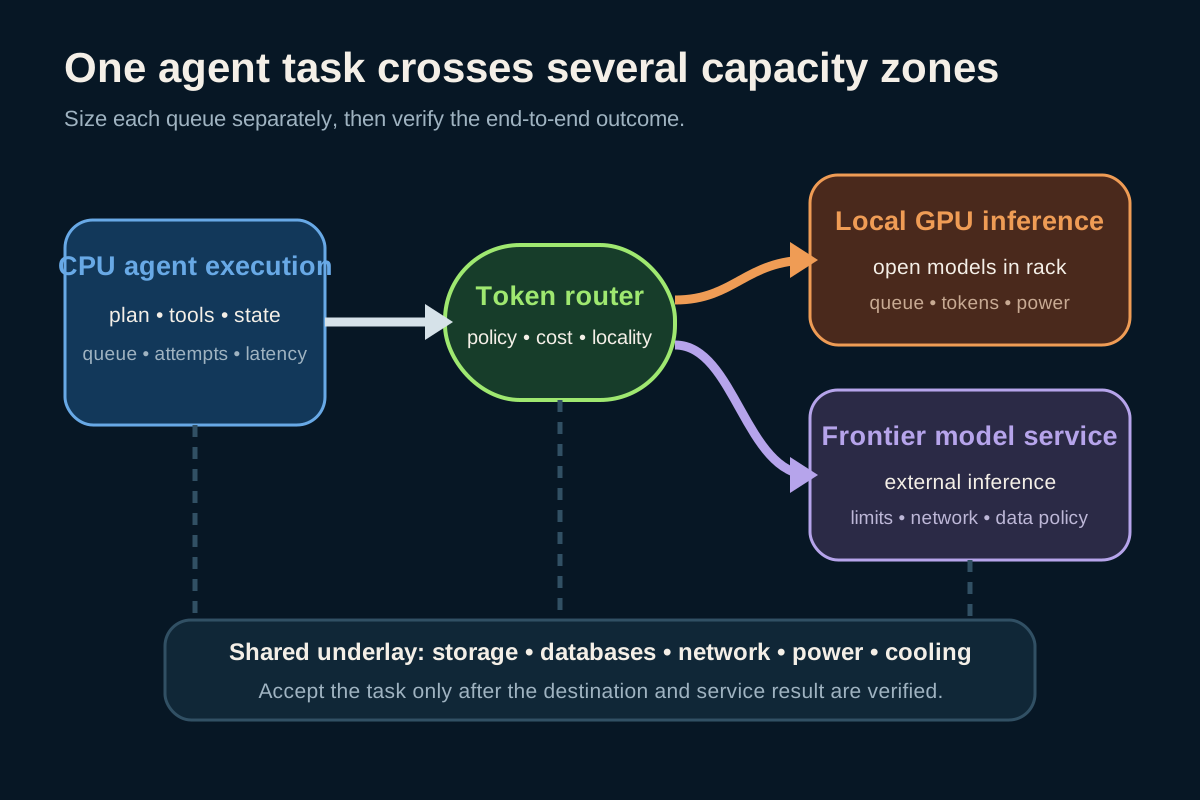
Helion matters because it treats CPU agent execution, model inference, routing, storage, networking, power, and cooling as different capacity zones joined by one task outcome. Size each zone as its own queue, give the token router an explicit fallback and data policy, and judge the platform by accepted tasks at the required latency and correctness.
Helion splits the agent path into compute zones
AMD's Helion product description presents a CPU-only hyperscale configuration and a mixed enterprise configuration. The CPU-only rack targets high-volume agent execution and can connect to model inference elsewhere. The mixed rack combines EPYC CPU blades, up to 16 Instinct MI350P GPUs, and general-purpose blades for database, storage, and technical computing work.
The enterprise design also includes a token router. AMD says it can direct model calls to frontier models in the cloud or open-source models running inside the rack. That makes routing part of the service path. The router now influences latency, cost, privacy boundaries, model behavior, and what happens when one inference destination is unavailable.
The result resembles a small platform rather than a single accelerator appliance. Agent loops consume CPU and network time between model calls. Databases and object stores retain state. GPUs handle demanding local inference. External model APIs remain another destination. The service succeeds only when those zones complete the same logical task.
CPU agent loops send model calls through a policy router to local GPU inference or an external frontier service while databases, storage, networking, power, and cooling support the complete task.
The token router needs a service contract
A router cannot choose a destination from model quality alone. It needs a policy that states which tasks may leave the local boundary, which models satisfy the required capability, how long the caller can wait, and what cost or capacity limit changes the route.
For a hypothetical enterprise support agent, a local model might classify requests and retrieve approved procedures. A frontier model might handle the small fraction of cases that need deeper reasoning. The router should preserve the task identifier, selected policy, destination, model version, latency, and result status. If the frontier service is unavailable, it needs an explicit choice: queue, fall back to an approved local model, or return a bounded failure.
Silent fallback is dangerous when models have different tool behavior or data boundaries. A response that looks plausible can still violate the application's structured-output contract or send sensitive context to a destination that was not approved. The inference compatibility suite provides the protocol checks that should accompany any routing change.
Capacity planning follows the stage that is saturated
AMD says the CPU-only rack can support up to 32,768 Zen 6 cores. The mixed configuration can include up to 16 MI350P GPUs and up to 102 terabits per second of network bandwidth. These are design maxima, not evidence that a particular agent fleet will use the rack efficiently.
Measure offered tasks and accepted completions through the whole path. Then attribute queue time and saturation to the CPU executor, token router, local inference queue, external provider, network, or state store. GPU utilization alone can look healthy while agents wait on CPU scheduling or a slow tool. CPU headroom can look plentiful while inference requests accumulate behind a model with a tight latency objective.
Useful GPU capacity can fall while the model endpoint remains available. Investigate demand, completed work, device conditions, and the physical owner together; a latency increase alone cannot distinguish a power constraint from a software or workload change.
That operating rule becomes more important in a mixed rack. Power and cooling are shared physical limits even when logical capacity is separated. Increasing CPU density can reduce the headroom available to local inference, and shifting work to an external model can trade rack pressure for network dependency and provider limits.
Measure routing and execution as one task
The task trace should connect the agent executor, router decision, model call, tool calls, and accepted outcome. Report routing distribution, queue time by zone, attempts per task, local and external inference latency, rejected demand, cost per accepted outcome, and unknown external actions. Keep the routing reason beside the destination so an operator can tell a deliberate policy choice from emergency spillover.
Run failure tests before scaling. Remove a local GPU destination, slow the state store, exhaust a CPU queue, and make the external model return a rate limit. Verify that the router follows the documented fallback and that the agent does not repeat completed actions when a response is lost.
The boundary changes with deployment. A hyperscaler using the CPU-only design may own the executor and connect it to a separate inference fleet. An enterprise may operate the complete mixed rack. A customer consuming an agent service may observe neither. Each team should measure to the deepest boundary it controls and avoid claiming root cause below it.
Helion is a blueprint before it is a result
AMD calls Helion an OCP specification-based blueprint and says it plans to contribute the specification to the Open Compute Project. Partner configurations are under development with availability planned for November 2026. The announcement names a broad hardware ecosystem, but it does not provide independent service benchmarks for a deployed agent fleet.
Helion is an OCP specification-based blueprint with partner configurations still under development, not independent evidence about a deployed agent fleet.
That is enough to make Helion technically interesting without treating it as proven capacity. The architecture recognizes a real problem: agent execution and model inference consume different resources, and a routing layer connects them. The next evidence should show how that separation behaves under representative tasks, failures, power limits, and routing policies.
The decision for operators is practical. Size CPU, GPU, network, and state capacity as related queues. Give the router an explicit contract. Then judge the rack by accepted tasks at the required latency and correctness, not by the largest number printed beside any one zone.
Source context
Source links appear within this article. Read them alongside the author’s analysis and evaluate the guidance against your environment.
Report an error or outdated detail