

On this page5 sections
Basalt is a specialized local inference engine for one model family and one GPU generation. Its narrow target is the point. Instead of carrying broad hardware and model compatibility, the project optimizes Qwen3.8-Flash-Next on Linux with NVIDIA Blackwell GPUs, while allowing experts that do not fit in VRAM to remain in system RAM or on a second GPU.
Consider a hypothetical internal inference service that must finish 64K-token code investigations for four concurrent users without refusing the request or moving the latency outside its objective. That complete job, not a peak token rate, defines the comparison.
The launch thread in r/LocalLLaMA reported 354 prose tokens per second, 665 structured tokens per second, and 7,317 prompt tokens per second at 64K context for an IQ3_XXS pack on an RTX 5090 plus RTX 5060 Ti. Those are the maintainer's measurements on a stated machine, not an independent benchmark. The useful operational question is what the design changes about fit, concurrency, and the measurements needed before using it behind a real service.
A narrow engine trades portability for control
The Basalt repository describes a C++ and CUDA engine, a Python server with OpenAI-compatible and Anthropic-compatible endpoints, conversion tools, tests, and a single-file model format. It requires Linux x86-64, AVX2, a Blackwell GPU with compute capability 12.0, CUDA 13, and enough system RAM for experts that do not fit in VRAM. AMD, Intel, older NVIDIA generations, Windows, and macOS are outside its target.
That boundary can be valuable when the serving fleet is already uniform. Kernels, memory placement, and model format can be shaped around one architecture instead of negotiated across many backends. The same boundary becomes a migration cost when a team expects to move the workload among dissimilar workstations or cloud instances.
Basalt repacks supported GGUF weights into a .basalt file with tokenizer data, chat template, the MTP drafter, expert profile, vision projector, provenance, and checksums. The repository says tensors are copied rather than requantized, except for an explicitly recorded compatibility conversion. The engine is MIT-licensed, while the model packs retain the Qwen Community License. Treat those as separate artifacts in any internal inventory.
Experts can move without becoming free
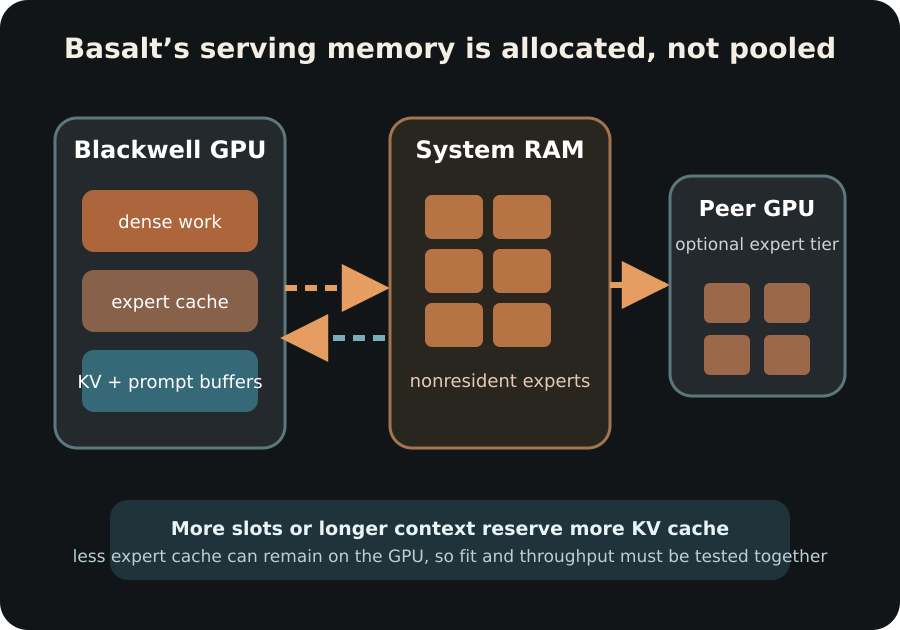
Qwen3.8-Flash-Next is a mixture-of-experts model. Basalt keeps the dense work and frequently used data close to the GPU, while experts outside the VRAM budget can live in system RAM and be streamed as needed. A second Blackwell card can act as a peer expert tier. This expands the set of workstation configurations that can load the model, but it does not turn system RAM into GPU memory.
Transfers still consume bandwidth and time. Resident experts, the expert cache, prompt buffers, speculative decoding state, and key-value cache all compete for finite capacity. A configuration that fits at startup can still perform poorly when the context grows or concurrent requests reserve more session state.
The server makes that competition visible. Its configuration can set the model, GPUs, context, KV format, expert-cache behavior, speculative decoding, and VRAM reserve. Startup output reports where KV cache is allocated and warns when batch slots leave too little room for the expert set. Those warnings are evidence about the selected configuration, not proof that another split is faster.
Concurrency divides context unless you pay for more cache
Basalt's --parallel option creates up to eight batch slots. By default, the configured maximum context is shared among them. Four slots under a 262,144-token maximum therefore receive 65,536 tokens each. Requests exceeding a slot's limit are refused with a 400 response. The alternative --slot-full-context gives every slot the full maximum, but multiplies KV-cache demand and reduces room available to the expert cache.
This is the first operational trap in the headline throughput number. Aggregate tokens per second can rise with more active slots while each request has less context, different latency, or a higher refusal risk. A team serving long code or incident histories needs to preserve the required per-request context while measuring concurrency. Otherwise the benchmark improves by changing the job.
Prompt processing and decoding also answer different questions. The maintainer reports high prefill rates and separate prose, structured, and chat decode results. A workload dominated by fresh 64K prompts may care more about time to first useful text. A queue of short structured decisions may care about completed decisions per second and tail latency. Copying the largest number into a capacity plan loses that distinction.
Reproduce the claim with your accepted workload
The Linux performance tuning guide develops the experiment design before a model-serving engine is involved.
A Linux tuning change needs a hypothesis about the bottleneck and a comparison under the same offered workload. Report latency, completed work, and rejections together so a protective reduction in demand is not mistaken for an unconditional performance gain.
For Basalt, begin with a versioned configuration and one model pack. Record the exact engine commit, pack checksum, GPU models, driver and CUDA versions, power limit, RAM, context policy, slot count, speculative settings, and prompt set. Use the project's tests before a service benchmark. The repository notes that some kernel parity tests require GPU data or locked-memory configuration, while file-format and cache tests do not.
Then replay a fixed arrival schedule with representative prompt lengths and output limits. Report first-text latency, completed-response latency, accepted completions, refusals, cancellations, and queue depth. Preserve warm and cold results separately. Prefix reuse can make repeated prompts inexpensive, but that describes a cached workload, not fresh operational evidence. The streaming LLM latency guide keeps first text, normal completion, refusal, and interruption as separate outcomes.
Quality also needs an application check. The project's model-card measurements publish perplexity, Kullback-Leibler divergence, and top-1 agreement against a Q8_0 reference for several packs. Those measurements characterize distance from that reference on the stated corpus. They do not establish that a quant is accurate enough for log diagnosis, code changes, or structured incident updates. Run a held-out task set and keep failures attached to the exact pack.
The server boundary still belongs to the operator
Basalt listens on 127.0.0.1 by default. Its documentation warns against exposing the server beyond that address without an API key, and the API key cannot be placed in the configuration file. A compatible endpoint is convenient, but compatibility does not supply authentication, tenant isolation, admission control, or production observability by itself.
If the required model already runs well on a broader engine, Basalt's narrower support needs a workload-specific benefit to justify another serving path. If the model does not fit or concurrency is the limiting factor, the specialized memory and batch controls may make a useful experiment possible.
The decision should be based on the exact work that must finish. Keep Basalt when its constrained target produces more accepted results within the required context and latency, and when the team can own its hardware and release boundary. A fast maintainer benchmark is a reason to test. It is not yet the service result.
Source context
Source links appear within this article. Read them alongside the author’s analysis and evaluate the guidance against your environment.
Report an error or outdated detail