

On this page4 sections
Anthropic released Claude Haiku 5.5 on October 7 with substantially lower token prices and new request and response behavior. For a service that classifies operational logs, the migration involves more than changing the model identifier. Old request settings can fail, a response can contain thinking without a usable answer, and a refusal needs its own path through the queue.
The launch announcement positions Haiku for high-volume work, including classification and extraction. For prompts up to 100,000 tokens, listed input and output rates are $0.10 and $0.50 per million tokens. Above that prompt threshold, they are $0.50 and $2.50. Anthropic reports an average cost reduction of around 75% relative to Haiku 4.5, accounting for changes in token use. That is a vendor assessment, not a saving measured by AIOpsSRE.
Those prices make a narrow classification service worth evaluating. The useful question is whether the same log evidence still reaches a defensible classification, including cases where the evidence cannot establish a cause. A faster route to an unsupported diagnosis would give the responder more correction work.
A timeout is evidence of a symptom
Consider a hypothetical service reading worker logs and attaching a classification to each investigation. Its input shows a timeout while a worker contacted a storage endpoint and an increase in queue age. It contains no observation from the endpoint itself. The classifier may identify a storage-request timeout, but those records alone cannot establish that the storage service caused the failure.
Give the service a result format that preserves that distinction. An illustrative accepted result could describe the symptom, cite the two record identifiers, mark the cause unresolved, and identify the endpoint observation needed next. A schema-valid result naming a storage outage would fail the semantic check because the supplied evidence does not support that conclusion.
This follows the operational prompting principle: unsupported certainty is an unsuccessful result. It changes the migration test itself. The new model must preserve the gap in the evidence, rather than receive credit merely for returning an allowed label. Otherwise a formatting improvement could quietly make the service more confident about something it has not established.
The old request may fail before classification
Anthropic’s Messages API migration guide says to replace manual thinking configurations using enabled and budget_tokens with adaptive thinking. It recommends omitting temperature, top_p, and top_k, and ending the message sequence with a user turn. Assistant-prefill patterns, such as a final assistant message containing an opening JSON brace, are rejected even when thinking is off.
A classifier that used prefill to begin its output needs a supported replacement, such as structured output where available or a tool with enumerated fields. The application still owns the check that a cited record exists and supports the proposed category. Enforcing the result’s shape cannot establish that relationship.
Keep a request failure attached to the original log item. If a client catches the error and substitutes an ordinary fallback category, the downstream system may treat an unclassified event as successfully processed. A visible unresolved item gives the responder or retry worker a truthful next step; an invented category hides why the model never classified it.
A successful HTTP response can still lack the answer
The Haiku behavior documentation explains that adaptive thinking is on by default. Content may begin with a thinking block, so a parser needs to select blocks by type instead of assuming the first block contains answer text. Thinking consumes the max_tokens allowance, and a small limit can stop generation before any text appears.
The same documentation says the newer tokenizer produces approximately 30% more tokens for the same input text than Haiku 4.5, with the exact increase depending on content. Recounting the classifier’s actual prompts and reviewing output headroom therefore matter even when its requested answer is short. A one-line classification does not mean all preceding computation fits a one-line token allowance.
Structured output does not remove every unsuccessful state. Its documentation says a safety refusal can arrive with HTTP 200 and an output that does not match the schema. Token-limit termination can also leave output incomplete. Checking transport status alone would count either case as a completed classification.
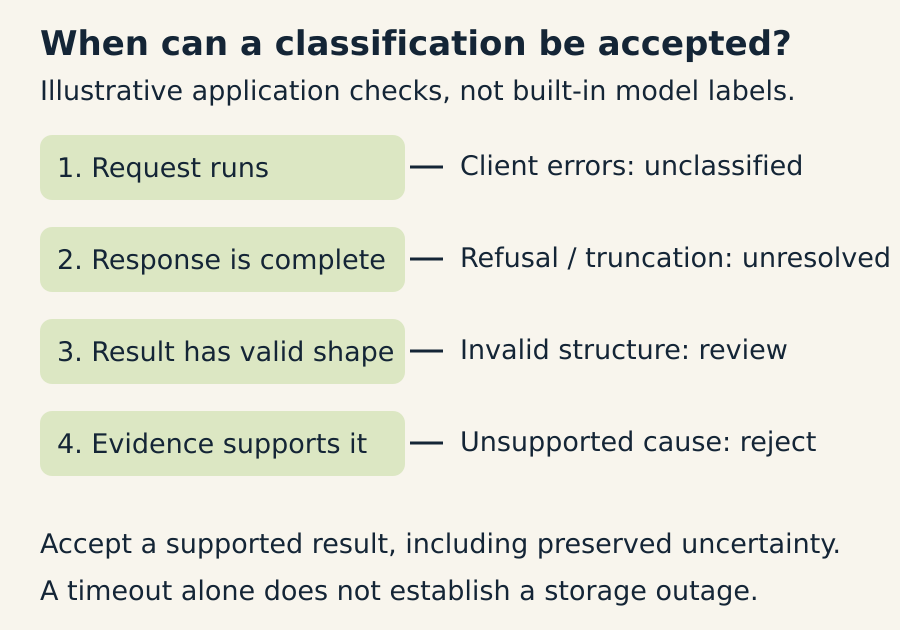
For the illustrative log service, these states need different treatment:
| Observed result | Classification state |
|---|---|
| Request or client error | The item remains unclassified. |
| Refusal or truncated output | The item needs an explicit unresolved path. |
| Valid shape with unsupported cause | The semantic evaluation rejects the result. |
| Valid result preserving evidence and uncertainty | The application can accept the classification. |
These are proposed application states, not built-in Haiku labels. Their value is that they keep an unsuccessful model attempt from becoming a false account of the underlying system.
Compare the exception, then tune effort
Use the model-evaluation approach: keep evidence and acceptance criteria comparable while evaluating the configuration. For the timeout case, retain the same logs and require both candidates to preserve the missing endpoint evidence. Add a case with independent endpoint evidence so the test also checks whether the service can recognize a supported conclusion.
The replay should exercise request validation, response parsing, and the eventual classification. Record which stage failed instead of merging all failures into a model-quality score. That distinction tells the engineer whether to repair the integration or adjust the model’s instructions and effort.
Anthropic’s prompting guidance identifies effort as the main cost and quality control. It also describes a specific interaction: with thinking off and structured JSON output, Haiku may skip a needed tool call. If this classifier must retrieve an endpoint observation, test that lookup directly; well-formed JSON is not evidence that it occurred. The same guide says repeated identical requests usually repeat a refusal, so an automatic retry is not a substitute for handling that result.
This migration guidance applies to Messages API integrations. The migration guide says Managed Agents requires only updating the model name, and Haiku 5.5 does not support Priority Tier. A Haiku 4.5 capacity commitment therefore needs separate planning, even if the classifier’s correctness checks pass.
For the log service, the release decision becomes concrete: the new request must run, its response must be handled, and its accepted classifications must retain the evidence needed by the responder. Haiku’s lower rates provide a reason to try that migration; the paired timeout cases establish whether the service can use the model without turning missing evidence into a diagnosis.
Source context
Source links appear within this article. Read them alongside the author’s analysis and evaluate the guidance against your environment.
Report an error or outdated detail