

On this page2 sections
Consider an illustrative conflict: an incident runbook recommends a restart, but a newer exception says to wait until replication catches up. A model can write a convincing explanation of the familiar remedy and still make the wrong operational decision. That is a useful test to put beside Anthropic’s lower-price and capability claims for Claude Opus 5.5, released September 22.
The release announcement lists $4 per million input tokens, $20 per million output tokens and $0.20 per million cache-read tokens. Anthropic says typical default-setting workloads cost 40% less than Opus 5, which is its workload result rather than a guaranteed saving for another organization. Opus 5.5 is available as claude-opus-5-5 on the Claude Platform and through AWS, Google Cloud and Microsoft Azure.
A restart instruction with a replication exception
For the restart case, the important result is whether the model carries the replication hold into its recommendation, even when the general runbook suggests acting now. The earlier model-evaluation guidance uses this distinction to separate useful operational reasoning from fluent explanation under the wrong constraints. Lower prices are most meaningful when the task remains one the team can accept.
Give both model configurations the general runbook and the newer replication exception. Ask whether they expose the conflict, maintain the hold and identify the evidence needed to proceed. The acceptance result can then be compared with cost. This is an illustrative evaluation case, not a reported Opus failure.
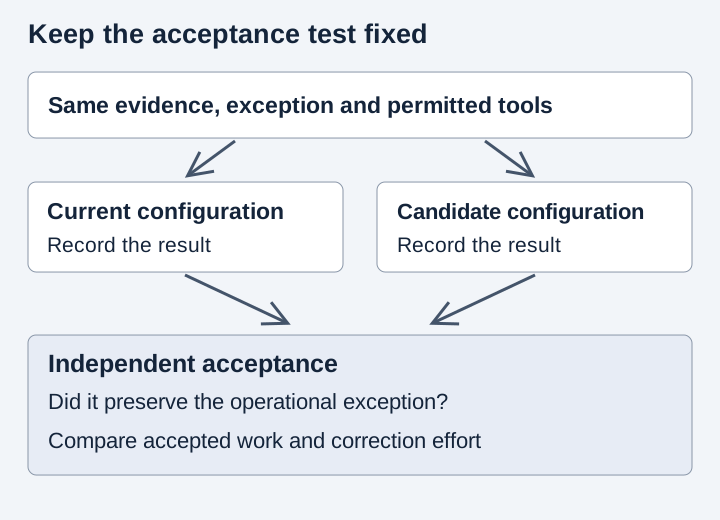
Hold evidence, permitted tools and acceptance criteria fixed, counting failed attempts and human corrections alongside tokens. If the new model overlooks the hold, repairing that decision is part of its cost. Excluding the correction would make a cheaper initial answer appear more useful than the completed workflow warrants.
The integration has a separate compatibility test
Anthropic says Opus 5.5 cannot run with thinking disabled. Its preserved-thinking rules govern whether the model can reuse reasoning blocks from earlier turns. A returned block must come from a compatible model, and the system prompt, tools and messages preceding it must remain unchanged. The context check applies by default to API accounts created on or after August 31, 2026; older accounts can enable it too. A client that rewrites earlier context can therefore receive an error or, if configured to drop invalid blocks, continue without that reasoning. Test this behavior before sending live traffic.
A successful request establishes that the client can call the model. The fixed exception case establishes whether the resulting decision is acceptable. Keep the earlier routing available until both pass, and limit a production trial to the task and permissions actually reviewed. This article has not independently benchmarked Opus 5.5.
Save the replication-case review with the configuration and compatibility result. The team can then decide whether this workflow becomes less costly while preserving the constraint that mattered in the first place. That is an operational reason to change routing, rather than a price reduction detached from the work it is meant to buy.
Sources & context
Sources linked in this article. Read alongside the author’s analysis; a citation does not independently verify a publisher’s claims.
- release announcementwww.anthropic.com