
On this page5 sections
Imagine a friend sending a short voice note: “Te espero en la entrada a las seis.” You are already putting on your shoes. You want to glance at the message, not play it aloud in a busy room.
A Spanish transcript would read, “Te espero en la entrada a las seis.” An English translation could read, “I'll wait for you at the entrance at six.” Both are useful. They are not the same request.
This is a hypothetical example, not a recording run through a model. But it gives us something ordinary to follow: a few seconds of sound becoming a sentence you can act on. With Whisper, the sentence is generated from the audio, not extracted as though somebody tucked a text file inside the recording.
Before there are words, there is a pattern of sound
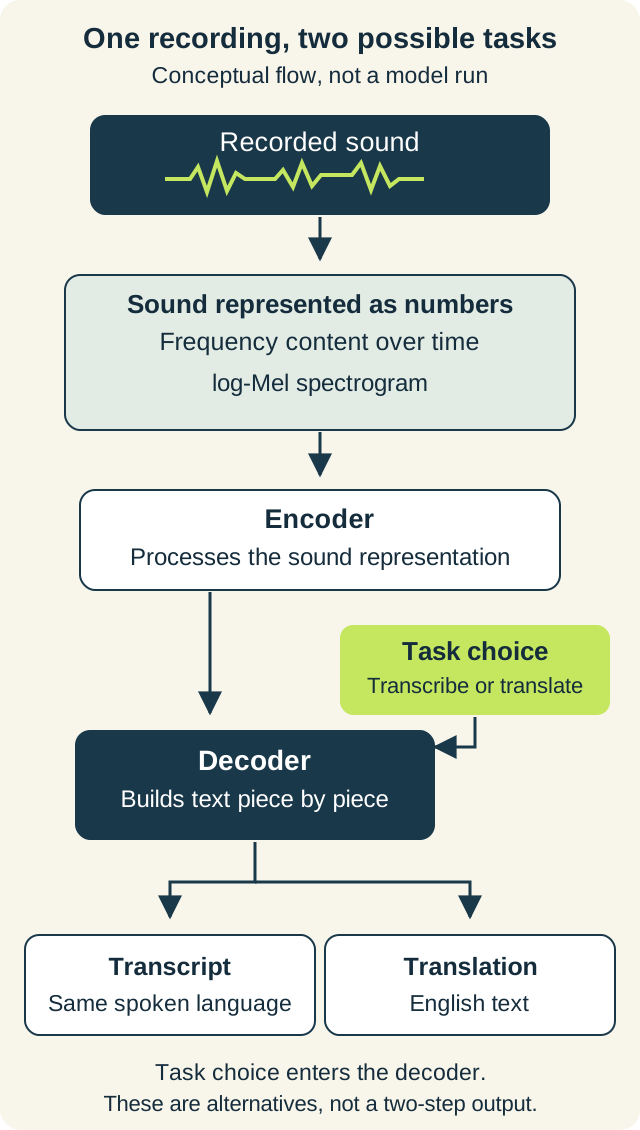
Play the note and you hear a voice unfold over time. A computer needs a numerical way to work with that changing sound. The original Whisper system converts audio into a representation of how energy at different frequencies changes over time, called a log-Mel spectrogram. Think of a chart with time along one direction and frequency bands along the other. It is a description of sound, not a page of tiny letters waiting to be enlarged.
An encoder, the part of the model that processes this input, turns that representation into information the next part can use. The decoder then generates text while drawing on that information. These two jobs, processing the sound and producing the text, are the central arrangement described in the Whisper paper.
Our friend's entrance and six have not arrived as ready-made fields. The system must produce a sequence of text that fits the recording. That distinction becomes easier to see when the same sound is asked to yield Spanish in one case and English in another.
The next piece depends on the pieces already chosen
Watch a transcript appear and it can look like words being lifted straight out of the speaker's mouth. Underneath, the decoder works with text pieces called tokens. A token is not necessarily a whole word. The system scores possible next pieces, chooses one, adds it to the sequence and continues.
The published decoding implementation shows several ways to make those choices. Temperature is a setting that controls randomness in sampling. At zero, its greedy decoder chooses the highest-scoring next token; at a nonzero setting, it samples from the scores. That choice does not certify that the text is correct. Beam search keeps several candidate sequences in contention instead of pursuing only one at each step. These are different ways of finding an output, not different audio recordings.
For our note, that means the text already selected participates in what comes next. The decoder is working with both the sound's processed representation and the growing output. It is not merely consulting a dictionary that pairs each isolated noise with a word.
This is also why a polished sentence is an interesting result, but not a second copy of the recording. We can read it much more quickly than we can replay the whole note. We still need it to preserve the friend's meaning.
Spanish on the screen, or English?
The task choice tells the system which kind of answer you want. Whisper uses special tokens to specify jobs such as transcription or translation, as well as whether timestamps are wanted. Those instructions enter the decoding process; they are not just a label attached after the sentence is finished. The original paper also describes training with preceding transcript text as context, helping the model use more than an isolated segment.
The model card draws a practical distinction: transcription produces text in the spoken language, while speech translation produces English. That does not mean every Whisper variant supports every task equally; the model and configuration still matter.
For the invented message, a Spanish-speaking reader may want the original wording. A reader who does not know Spanish may want the English translation. Neither person asked for “Meeting at six,” a shortened summary that drops the entrance. Summarizing is another job. Neither output establishes the speaker's identity, either.
So an English sentence appearing from Spanish audio need not mean the recognizer got the language wrong. It may have been asked to translate. Before treating the result as a transcription failure, look at the job the application actually requested.
When the sentence sounds better than the recording supports
Suppose, in a deliberately invented bad output, six becomes seven. The sentence still reads smoothly. The person putting on their shoes now has the wrong time.
That is one kind of mistake. Repeating a phrase, losing words at a segment boundary or producing speech that was never in the recording are different problems. The original paper discusses those distinctions. The model card also reports unspoken generated text and offers a hypothesis about the interaction between language prediction and transcription. It does not establish one cause for every bad result.
The architecture helps explain why fluent output is possible; it does not diagnose a particular error by itself. A neat transcript with the wrong time and a repetitive transcript need not have failed in the same way. For this note, the useful check is wonderfully small: replay the part containing the time and compare it with the text. The whole paragraph need not be a disaster for one word to matter.
That is a proposed reading habit, not a reported accuracy test. No Whisper model was run for this article.
Whisper is a family, not one frozen specification
Suppose two apps both say they use Whisper. That familiar name does not tell you whether they use the same model. The mechanism has stayed recognizable while some of its ingredients have changed. The original paper describes 680,000 hours of training audio and an input with 80 Mel channels, the frequency bands in that sound representation. Those figures belong to that system, not every later model carrying the Whisper name.
The large-v3 model card instead specifies 128 Mel bins and training on one million hours of weakly labeled audio, meaning audio paired with text labels that are not guaranteed to be accurate transcripts, plus four million hours labeled using large-v2. Those machine-produced labels are not four million hours of human-reviewed transcripts. The card also discloses that its text combines Hugging Face contributions with material from the original card.
For someone choosing an app, the useful question is which model it actually uses. A familiar name alone does not settle its input details, task support or accuracy on your recording. More training data is not a promise that a particular name, accent or time will come through correctly.
Back at the door, the little voice note has done something valuable: it has become words you can glance at while getting ready. Keeping Spanish preserves one kind of access; translating into English provides another. Understanding the trip from sound to generated text lets you ask for the right one, and know when to press play again.
Sources & context
Sources linked in this article. Read alongside the author’s analysis; a citation does not independently verify a publisher’s claims.
- Whisper papercdn.openai.com
- published decoding implementationgithub.com
- model cardgithub.com
- large-v3 model cardhuggingface.co