

On this page6 sections
Imagine choosing a model to summarize long support cases on a machine that already has other work to do. One download needs far more memory than you can spare. Another version of the same model promises four-bit weights. It is much smaller. What did the people making it take out?
Usually, they have not removed three quarters of the model. They have given its learned numbers a more compact, less precise representation. That is quantization. It can make a model fit on a laptop, free space on a graphics processor, or GPU, and reduce how much data must move while it produces an answer. The useful question is what happens to the work you wanted it to do.
For a hypothetical model with eight billion weights, storing each at sixteen bits takes about 16 GB before overhead. Four bits brings that idealized total to 4 GB. The saving is substantial, but it comes from changing how numbers are represented. Hugging Face’s quantization overview explains the precision tradeoff. We can see it happen to a single number before asking whether our support cases will still fit.
Eight billion numbers, written more compactly
The model's weights are numerical settings learned during training. When it produces an answer, it uses those settings in its calculations; that use of the trained model is called inference. The model-weights guide covers how training changes the numbers, and the inference guide follows a request through them.
Weight quantization leaves the network structure in place while giving many or all weights a smaller representation. An eight-billion-parameter model generally still has eight billion parameters, the learned numerical settings. Taking up a quarter of the storage does not turn it into a two-billion-parameter model.
Four bits, each a zero or a one, offer only sixteen possible patterns. The quantization scheme decides which numbers those patterns stand for. They might be evenly spaced integer codes used with a scale, or a different selection of values. In the QLoRA paper, NF4 is a four-bit format designed for normally distributed weights: values following a bell-shaped distribution. The name on the format matters because sixteen choices can be arranged in different ways.
You may also see “weight-only” on a model description. It tells you what was compressed. Intermediate numbers produced between the model's layers, called activations, can be quantized too, but not necessarily in that version. Temporary values, calculations and caches need not share the weights' precision.
Watch 0.26 become 0.30
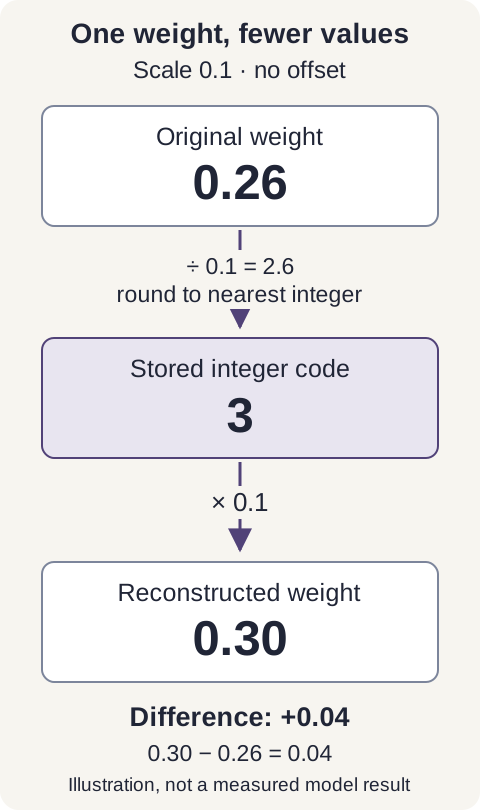
Take a deliberately simple illustrative scheme that stores an integer code, uses a scale of 0.1 and has no offset. Divide a weight of 0.26 by the scale: 0.26 ÷ 0.1 = 2.6. Round that to the code 3. Later, multiplying 3 by 0.1 reconstructs 0.30.
The original 0.26 has become an approximation, with an error of plus 0.04. If this weight multiplies an input of 1.5, its contribution changes from 0.39 to 0.45. That is a visible change in one calculation. A real layer combines many contributions, so this little example cannot predict the quality of the final summary.
Read diagram description
Divide 0.26 by the scale 0.1 to get 2.6, then round to the integer code 3. Multiply the code by 0.1 to reconstruct 0.30. The difference between 0.30 and 0.26 is plus 0.04.
One scale makes the example easy to follow. Real schemes can give different groups of values their own scales, and may use an offset called a zero-point. Those extra numbers take space, but let a group use a range that fits it better. The integer-inference quantization paper describes the mapping; NVIDIA’s quantization guide explains how scales can be shared across groups.
Why bother with groups? A few unusually large values can stretch a shared range until nearby small values become difficult to tell apart. AWQ uses statistics from the activations and scales important channels, groups of related values, to reduce that loss. GPTQ uses information about a layer's behavior to limit the error introduced when its weights are quantized. They address the approximation differently; neither is a promise that every task will come through unchanged.
The file fits. Now the requests arrive.
Here is the compact weight calculation for our hypothetical eight-billion-parameter model:
8,000,000,000 parameters × 4 bits ÷ 8 bits per byte = 4,000,000,000 bytes
That is 4 GB in decimal units, or about 3.73 GiB. It counts only ideally packed weight values. The scales we just discussed still need storage, along with other quantization information, any weights left at higher precision and file metadata. For example, Hugging Face’s GGUF format guide describes Q4_K blocks as using 4.5 bits per weight once their block information is included. The “4” in a label cannot do the whole file-size calculation for us.
Now imagine our summary service loads that model and replies to a short greeting. Good: startup and generation work. But the intended job is several long support cases arriving together, and the running process needs space for those as well.
A transformer processes text in units called tokens. Its attention calculation relates the current text position to earlier ones. As it generates text, it retains information from those earlier tokens, letting it reuse parts of that calculation rather than repeat them. That storage is the key-value cache. Longer sequences and more simultaneous requests can enlarge it, depending on the model and cache design. Compressing the weights does not automatically compress this cache. Transformers cache documentation describes cache quantization as a separate option, with its own compatibility and response-time tradeoffs.
The machine has other occupants too. With shared memory, the operating system and other applications need room in the same pool. With a discrete GPU, system RAM and GPU memory are separate resources. Knowing that a file occupies 4 GB does not establish whether either arrangement can handle the support queue.
Less to move, but still work to do
Producing an answer involves moving data as well as calculating with it. If the device spends much of its time bringing weights from memory to the units doing the calculation, smaller representations can reduce that traffic. The benefit does not require every operation to happen directly on four-bit numbers.
The software running the model still needs an appropriate kernel, the low-level routine that performs an operation. It may unpack stored values and use a different precision for arithmetic. The Bitsandbytes integration documentation demonstrates four-bit storage with bfloat16, a sixteen-bit format, for computation. Those are separate settings because storage and calculation are different jobs.
Unpacking takes work, hardware differs and a batch of requests can stress a device differently from one chat. Four times smaller therefore does not imply four times faster. The method-selection guide explicitly cautions that an inference speedup is not guaranteed.
For our service, fitting the real workload into a useful memory arrangement might be the main gain, even if tokens appear at much the same pace. If the existing setup already has plenty of room, a more aggressive conversion might bring little benefit. Compare memory use alongside time to the first useful response, total completion time and how many simultaneous requests finish acceptably.
A smaller representation is not a new lesson
Return to 0.26 and its approximation. If we take a model that has already been trained and convert its numbers afterward, that is post-training quantization, or PTQ. Some methods first use calibration inputs to observe behavior and guide the conversion. GPTQ describes one such approach. The job is representing what the model has learned, rather than teaching it a new subject through ordinary training.
Another approach lets training account for the approximations, giving the model a chance to adapt to their effects. That is quantization-aware training, or QAT. The integer-inference quantization paper pairs a quantization scheme with a training procedure intended to preserve accuracy. Our small rounding example shows the kind of numerical change that training must accommodate.
What if the support service also needs the model adapted to its work? QLoRA freezes the quantized base and trains a small set of added LoRA parameters instead. The added settings change; the base weights stay frozen, making fine-tuning more memory-efficient. Downloading a four-bit model has not performed that training for your support categories or operating environment. The LoRA guide explains the separate adaptation decision, and the QLoRA paper describes the method.
Put the support cases back in the comparison
Choose a model capable of the task and a representation your intended hardware and runtime support. GGUF is a file format, AWQ a quantization method, and bitsandbytes a library providing quantized operations. Sharing a bit count does not make their files and settings interchangeable. The ninfer-ext article follows a concrete case of an encoding and loader needing to agree.
For our hypothetical service, compare candidates on the same support cases. Check that each summary keeps the customer's problem, the actions already tried and the questions still open. Include long cases and ones where a small qualification changes the meaning. Then compare memory and completion behavior with as many concurrent requests as the service is expected to handle. This is a proposed evaluation, not a test run for this article.
Different precisions of the same base model help isolate what the conversion changed. A larger quantized model compared with a smaller higher-precision one answers a different question: which complete option serves this workload better? Both comparisons can be useful, but a benefit from changing the base model should not all be credited to quantization.
The smaller download got the model onto the machine. The support cases tell you whether it belongs there. Keep the version that leaves room for the work and preserves the details the next person needs, rather than choosing by the four-bit label alone.
Source context
Source links appear within this article. Read them alongside the author’s analysis and evaluate the guidance against your environment.
Report an error or outdated detail