

On this page8 sections
The dependency update passes the tests. Then a caller takes a path the suite never exercised, and the application behaves differently. Changing the package was the easy part. Preserving the behavior people depend on is the work still waiting.
Google positions Gemini 4 Argon as its flagship reasoning model for complex software engineering, research and multi-step tasks. Its model documentation lists text, image, audio, video and PDF inputs, text output and tool support. That makes it a candidate for following a migration through its callers and failures, not proof it will finish yours well.
Identify the model and the tools around it
Gemini names both a model family and Google’s chat app. Argon is a model; Antigravity is a development environment. The API lets developers use the model in their own software. In chat it reasons about supplied files. A coding agent can add file lookup, edits and tests, returning results for another response. A demo shows that combined setup.
Google announced Argon on September 30 and broader availability on October 13. The October release post describes API, AI Studio and paid consumer/coding access. Check the selector and entitlement in the product you plan to use. A consumer subscription and API billing are separate decisions.
Watch what happens when the first fix breaks a caller
The revealing moment comes when fixing one caller breaks another. Does the assistant distinguish a bad edit from a broken setup or an unwritten requirement? Can it choose another step without losing the behavior the migration must preserve?
That is what long-horizon work asks of a system: later steps depend on earlier choices, and some choices prove wrong. A long conversation alone does not show that the work is being handled well.
Google’s engineering examples describe migrations, memory optimization and a Rust video decoder. Those are vendor reports, not measurements made here. Their repeated experiments, compiler checks and review are reasons to evaluate the whole working loop, not just its first answer.
A refactor, two conflicting research sources or a complete website interaction can pose a similar test. These are prospective uses. Another caller, a contradictory passage or an empty input gives the assistant a reason to adapt while keeping the original requirement.
Give the large window a well-organized brief
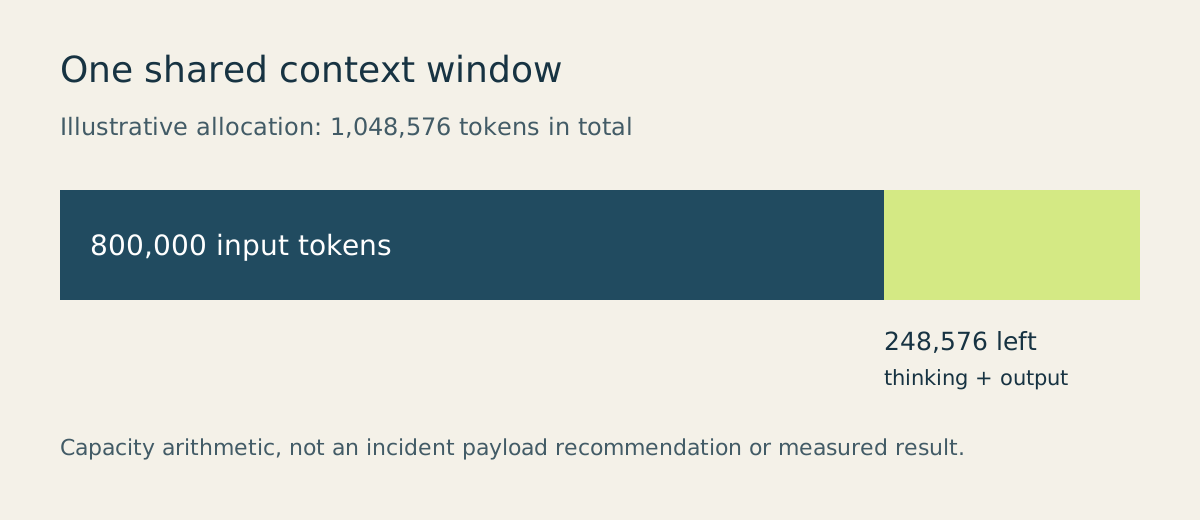
Argon shares 1,048,576 tokens across input, thinking and output. A token is an encoded chunk of content. The default synchronous generation cap is 65,536 tokens including thinking, not that many guaranteed visible answer tokens. Longer generation uses background execution or continuation and still fits within the shared window, as the API guide explains.
There is room for a substantial brief, including a substantial amount of conflicting information. A year of chat and two incompatible architecture documents may all fit. The window does not decide which description is current.
Label sources and dates, identify the decision and ask for supporting passages. A code change needs relevant files, expected behavior and a way to check it. A paragraph rewrite may need only the paragraph and its audience. Extra space helps when the material has a purpose.
The busiest CPU chart may not explain the failure
Consider a constructed investigation; no Argon run was performed. After deployment, a service returns more 503s. A screenshot shows rising CPU, and the incident channel suspects heavier code.
Then three observations arrive: errors occur in only one zone, all zones run the same version, and the affected zone loses ready endpoints before CPU rises. A version-only explanation becomes less convincing. The cause remains unestablished.
Compare readiness failures, pod events and rollout timing. Did fewer ready replicas concentrate traffic and precede the CPU rise? Scaling merely because the screenshot looks busy would skip the observations that distinguish these explanations.
Follow a citation back to its source and inspect the most consequential inference. Even a neatly arranged answer can misread a timestamp. The useful explanation accounts for the zone and event order rather than simply shortening the logs.
Pick a trial you can finish reviewing
| Your work | A bounded trial | What to inspect |
|---|---|---|
| Software development | Change one interface and update its callers. | Existing behavior still passes, and the new path is exercised. |
| Research or planning | Reconcile two documents that disagree. | Each disputed claim links to the right passage and version. |
| Operations | Investigate a sanitized, closed incident. | The evidence supports the diagnosis without hindsight leaking into the prompt. |
| A personal project | Add one complete user interaction. | You can perform it from start to finish, including a failure case. |
Compare Argon with your current tool on a small representative set, keeping inputs and acceptance criteria the same. Count evidence accuracy, unsupported conclusions, useful next checks, elapsed time and total cost, including correction and review. A fast patch followed by an hour of cleanup has transferred work, not removed it.
Choose the improvement that matters before a polished answer wins the comparison: fewer missed requirements, clearer explanations, quicker usable completion or a lower total bill. Adopt where the observed result justifies the change.
Count the cost of the completed job
The standard API rates are $2 per million input tokens and $10 per million output tokens through November 30, 2026, then $4 and $20 from December 1. Thinking is billed as output. A hypothetical 100,000 uncached input tokens plus 20,000 billed output tokens costs $0.40 at introductory rates or $0.80 at the announced later rates, before tools and other services.
A migration can take several requests to inspect failures and revise the patch. Count the whole sequence. The first response is an attempt; the thing you need is a completed task.
Argon offers low, medium and high thinking settings, defaulting to medium. Compare them on the same bounded job rather than assuming more computation always earns its cost.
Start with one request and retain its result
AI Studio offers a place to explore prompts. The API supports repeatable inputs, retained outputs and integration. Argon requires paid Gemini API access and is not available on the API Free tier. A consumer subscription does not establish API billing.
Follow Google’s setup instructions, install or update the SDK with pip install -U google-genai, enable paid access and set GEMINI_API_KEY. Define proposal_text as a fictional migration proposal. Credentials belong outside that text and your source code.
The following unexecuted example uses the documented Interactions API pattern. It sends a model request; it does not grant an agent access to files.
from google import genai

# Configure GEMINI_API_KEY in your environment.
client = genai.Client()

result = client.interactions.create(
    model="gemini-4-argon",
    input=(
        "Read this fictional migration proposal. "
        "Identify conflicting requirements and explain "
        "which evidence would resolve each conflict.\n\n"
        + proposal_text
    ),
    generation_config={"thinking_level": "medium"},
)

print(result.output_text)
Compare the response with the proposal. It may expose conflicting requirements, but deciding which requirement the application should preserve remains a separate decision.
For a longer job, retain its identifier, inspect terminal status and usage, and handle failure. A spinner can reassure someone that activity continues. It cannot serve as the application’s durable completion record.
Finish where the user’s requirement is met
The migration finishes when callers behave as required and checks reach paths the old suite missed. The zonal investigation succeeds when its explanation fits the observations and its next check separates competing causes. Neither finish line is measured by token capacity.
Choose one such job, keep the full record and compare it with your existing approach. Then Argon earns a place through work it demonstrably helps finish, with cleanup and checking still included in the time.
Sources & context
Sources linked in this article. Read alongside the author’s analysis; a citation does not independently verify a publisher’s claims.
- model documentationai.google.dev
- October release postblog.google
- engineering examplesblog.google
- API guideai.google.dev
- pricing pageai.google.dev