

On this page4 sections
NVIDIA’s October 12 announcement is easy to read as one large hardware launch. It is more useful to split it into three different kinds of deliverable: designs that have been contributed to an open standards body, operations software that can be inspected today, and hardware plans whose performance still belongs to future implementations.
The company contributed Vera Rubin rack and compute-tray designs to the Open Compute Project through its MGX architecture. NVIDIA, AMD, Google and Meta also published facility-design principles, while Google, Meta, Microsoft and NVIDIA published a grid-disturbance specification. Alongside those documents, NVIDIA released or highlighted open-source DSX components for switch configuration, cluster readiness, rack management and bare-metal provisioning.
That combination matters because an AI cluster does not fail neatly at the GPU boundary. Power, cooling, network configuration, firmware, workload admission and recovery all determine how much useful work the system completes. Opening more of those interfaces gives operators something concrete to inspect and test. It does not turn a reference design into proof that a particular deployment is ready.
Four layers opened at different levels
The physical contribution starts with rack and compute-tray designs. NVIDIA says the MGX 1.2 work includes blind-mate liquid cooling, interoperable rack-scale interconnects, a liquid-cooled 5,000-amp busbar, configurable I/O bays and common power and cooling interfaces. The company describes support for rack deployments up to 250 kilowatts. These are design targets and interfaces that manufacturers can build against, not field measurements from every system that will carry the label.
The facility layer reaches beyond the rack. The Open Compute Project now lists Open Data Center design principles version 0.7.0 and a version 1.0 interface specification for data-center behavior during utility-grid disturbances. NVIDIA summarizes the latter as staying connected, responding automatically and returning near full load in less than two seconds. An operator should read the actual OCP specification and map its requirements to the local utility agreement, protection scheme and restoration procedure rather than treating that summary as a universal service guarantee.
The network announcements mix current standards work with future hardware. NVIDIA and Cisco plan a community-led specification for Ultra-Dense Small Form Factor Pluggable optics. The companies say the proposed USFP design is intended to support 400 gigabits per second per lane, up to 12.8 terabits per second of module capacity, four times the bandwidth density and roughly 1.3 times the power efficiency of current 200-gigabit-per-lane pluggables. The key words are plan, designed and intended. Cisco’s own announcement calls the open specification upcoming.
The software is the most immediately inspectable part. NVIDIA’s DSX documentation now links operators to source for Config Manager, Cluster Readiness Engine, Rack Management Service and the Cluster API provider for NVIDIA Infrastructure Controller. Their maturity differs. The Config Manager repository explicitly calls itself a developer preview and says it is not recommended for production use. Cluster Readiness Engine publishes versioned charts, images and runnable workload definitions, which makes a pinned lab evaluation possible without pretending the entire DSX stack has one release status.
Open interfaces change the test, not the verdict
An open design makes dependencies visible enough to test. A common rack interface can reduce one-off mechanical and electrical integration. A public controller exposes its reconciliation logic, APIs and release history. A shared network form factor can support multiple suppliers. Those are valuable improvements because they narrow the number of hidden assumptions between vendors.
They also move responsibility toward the integrator. A rack built from published interfaces can still combine firmware, cooling equipment, network profiles and facility controls that were never validated together. A readiness tool can report that its jobs passed while the test omitted the failure mode that matters to the production workload. Source availability improves inspectability; it does not select the acceptance criteria.
A useful operating rule for AI infrastructure applies here. Useful GPU capacity can fall while the model endpoint remains available. Demand, completed work, device conditions and the physical owner need to be investigated together because latency alone cannot distinguish a facility constraint from a software or workload change. The October 12 release gives operators more places to collect and challenge that evidence, but the decision still belongs at the workload boundary.
Turn each artifact into an acceptance case
Consider a hypothetical operator evaluating a new liquid-cooled inference cluster. The system boots, the readiness controller passes an NCCL bandwidth run, and the model endpoint answers traffic. That establishes useful facts, but it does not yet show that the cluster can survive a cooling-loop transition, a network-plane loss or a grid event while meeting the service objective.
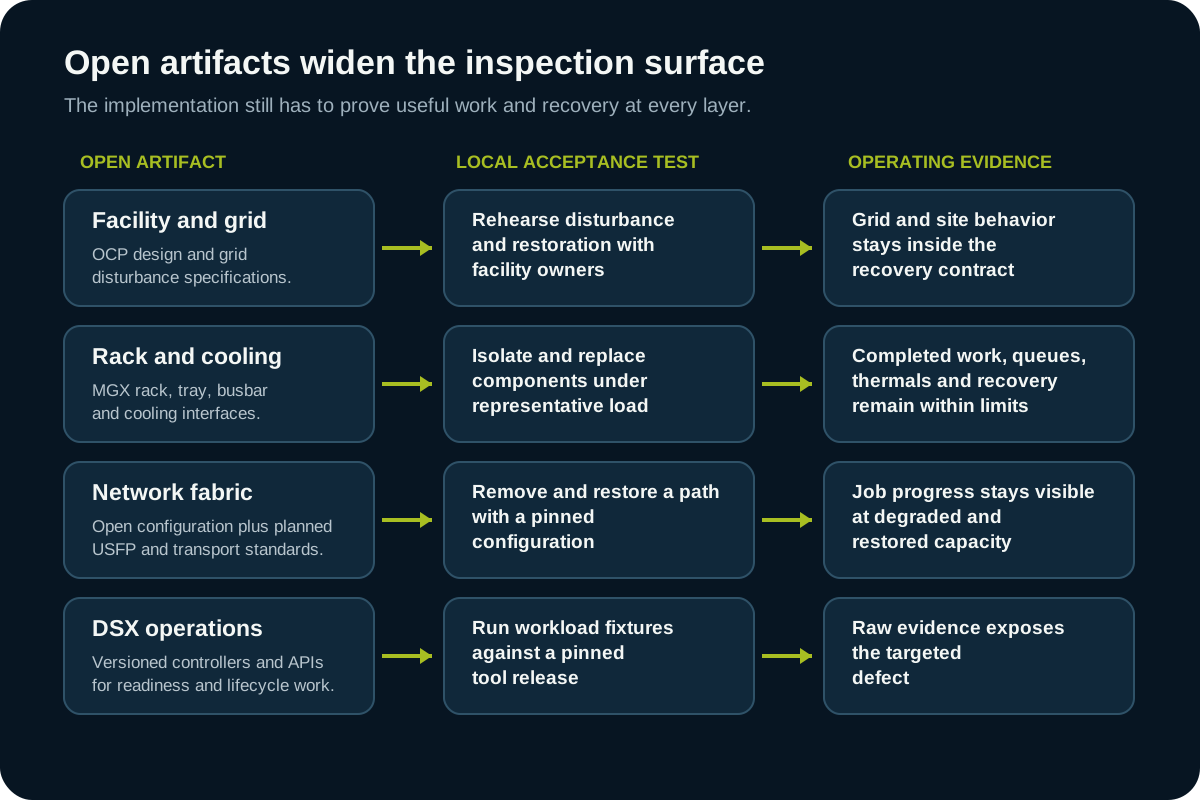
The acceptance plan should connect each newly open artifact to a result the operator can observe:
| Open artifact | Local test | Evidence that changes the decision |
|---|---|---|
| Rack, busbar and cooling interfaces | Exercise component isolation, replacement and return to service under representative load. | Completed work, queue growth, temperatures, power limits and recovery time remain within the service boundary. |
| Grid-disturbance specification | Rehearse the agreed disturbance and restoration sequence with the facility and utility owners. | The site follows the required electrical behavior without turning workload recovery into a second overload. |
| Network configuration and fabric | Apply a pinned configuration, remove a path and restore it while collecting congestion and job-progress signals. | Traffic moves as designed, degraded capacity is visible, and recovery does not strand or silently restart work. |
| Cluster Readiness Engine | Run versioned workload fixtures that match the training or inference path before admission. | The exact cluster, tool version, policy and raw results are retained, and the fixture can fail for the targeted defect. |
This is where the difference between a reference architecture and a recovery path becomes important. A validated design is evidence about the configuration that was tested. It is not a promise about your repair time, spare capacity, rollback path or operator permissions. Run representative access patterns and at least one cold recovery before using the architecture to justify a capacity or availability claim.
The release is a starting point for operators
Teams can act on the software and published specifications now. They can pin the Cluster Readiness Engine release, inspect its APIs, build workload-specific checks and compare intended network configuration with observed state. Facility teams can review the OCP documents against their own power, cooling and grid contracts. System builders can evaluate the MGX contribution as an integration target.
USFP needs a different disposition. NVIDIA and Cisco announced plans for a future open specification and hardware ecosystem, so its density and efficiency figures should remain vendor-stated design claims until actual modules, systems and representative tests exist. The same restraint applies to any performance or resilience claim inferred from the broader Vera Rubin platform.
The most important change is not that the infrastructure has become automatically reliable. It is that more of the path from grid to workload is becoming inspectable, versionable and testable. Use that access to build acceptance cases around completed work and recovery, not to skip them. An open blueprint is valuable precisely because operators can challenge the implementation that emerges from it.
Source context
Source links appear within this article. Read them alongside the author’s analysis and evaluate the guidance against your environment.
Report an error or outdated detail