

On this page4 sections
Claude’s October 7 update adds monthly API credits for Max and Team subscribers. It does not, according to Anthropic’s current guidance, remove subscription access to the Agent SDK or claude -p. That distinction matters for an operations team deciding whether its scheduled agents need new credentials, a different budget, or any migration at all.
A Reddit discussion framed the change as an end to subscription use. The current help article says those subscription paths remain available. It also records that the previously announced Agent SDK usage changes were paused on June 15. Reading the October update as a completed withdrawal would send engineers toward an unnecessary migration.
The useful change is that eligible subscribers can fund applications through a separate Console balance. That gives a team another way to run an agent, while leaving it responsible for deciding how much unsuccessful work the agent may accumulate before handing the task back.
The same command can spend from a different balance
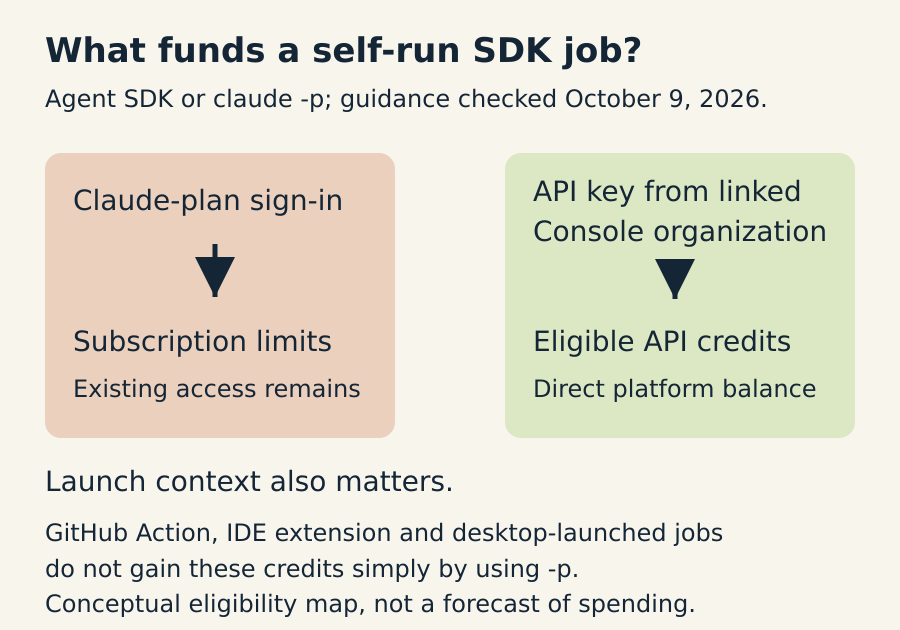
Anthropic’s billing FAQ distinguishes self-run claude -p and Agent SDK jobs by their authentication. Signing in with a Claude plan consumes its usage limits. Running them with an API key from the linked Console organization can consume the new API credits instead. The command’s name alone does not identify its billing path.
The FAQ makes a further distinction for runs started by the Claude Code GitHub Action, an IDE extension, or the desktop app. Those count as Claude Code usage and do not become eligible for these credits simply because a run uses -p. An engineer diagnosing an unexpected charge therefore needs the launch path as well as the credential source.
For an illustrative scheduled backup-review agent, record the intended Console organization and authentication mode in the job configuration. Keep the secret itself in the existing credential store. The purpose of that record is to explain which balance a job was meant to draw from, without putting an API key into its logs.
Included credits are a shared resource
The Platform documentation lists $100 monthly for Max 5x and $200 for Max 20x. Team receives $20 per Standard seat and $100 per Premium seat, pooled with a $500 ceiling. Free, Pro, and Enterprise plans are not eligible for this credit program. One plan links to one Console organization, whose keys and workspaces share its balance.
Unused credits expire rather than roll over. If they run out, purchased credits or configured auto-reload can keep requests running; without another balance, API requests stop. These credits apply to the direct Claude Platform, not Bedrock, Google Cloud, Microsoft Foundry, or Claude Platform on AWS. Moving credentials between platforms would not carry the benefit with them.
For the backup-review example, a shared balance connects jobs that otherwise seem independent. A development experiment can spend money the review queue expected to use. Separate workspaces and workspace spend limits help constrain that exposure, but the team still needs an allocation for the queue’s actual work. A subscription benefit has supplied funding, not an operational priority order.
A useful backup investigation costs more than its first answer
Suppose, hypothetically, that the agent gathers failed backup records, looks up the relevant runbook, and produces an evidence bundle for a responder. Acceptance requires the affected backup identifier, the failure evidence, and a cited recovery condition. A plausible paragraph that omits the condition is an unfinished task, even if the model returned normally.
Keep retrieval, retries, and verification attached to that task. This follows the task-budget principle: calculate the resources needed for a useful outcome before optimizing an individual call. It also gives the new shared credit pool a sensible unit of planning. The pool pays for work across attempts; the responder needs an investigation they can use.
Consider an illustrative ledger of 100 attempted investigations. Their combined estimated model cost is $72, and 60 bundles are accepted. Cost per started investigation is $0.72, while cost per accepted bundle is $1.20. Neither number includes the reviewer’s time. Both are arithmetically correct, but the first would overstate the value delivered if presented as the price of a completed investigation.
That is the attribution problem: rejected work and corrections need to remain connected to the result. If a prompt change lowers the model spending while leaving more bundles for responders to repair, the credit lasts longer without establishing that the workflow improved. Record acceptance and correction work alongside the spending so the team can see that difference.
Keep a task limit outside the retry loop
The Agent SDK exposes maxBudgetUsd in TypeScript and max_budget_usd in Python. Its agent-loop documentation describes these as estimated-spend thresholds, not exact invoice ceilings. Checks happen after responses arrive, so the response crossing a threshold still costs money, and running subagents can add spending before they stop. Subagent budget-cap enforcement requires Claude Code v2.1.217 or later.
An application that launches another call after a failed attempt needs a limit spanning those calls. For the hypothetical backup task, that could mean retaining a remaining allowance under the original task identifier, leaving room for verification, and returning an unresolved bundle when the allowance is exhausted. Restarting the process should not silently grant the same investigation a fresh allocation.
The cost-tracking documentation adds an accounting trap: normally exited resumed sessions with Claude Code v2.1.277 or later restore earlier spending into their result totals. Summing those cumulative totals double-counts work; older versions reset resumed-call totals. Independent calls have separate totals, so the aggregation rule depends on the session relationship and installed version. SDK dollar values are client estimates; reconcile them with Console billing or the Usage and Cost API.
For a queue running in the background, missing accounting should leave the task’s spending unresolved rather than turn it into zero. Preserve the job outcome too. Credit exhaustion, a budget stop, and an accepted investigation require different queue decisions even when none produces another model call.
The October update therefore creates a useful funding choice without requiring a blanket access migration. Check the actual launch and authentication path first, then give the backup-review queue an allocation that includes unsuccessful attempts and verification. The benefit becomes operationally useful when the team can explain both where the credit went and which investigations reached a usable result.
Source context
Source links appear within this article. Read them alongside the author’s analysis and evaluate the guidance against your environment.
Report an error or outdated detail