

On this page3 sections
Aleph Alpha has released Kolibri, a German- and English-focused language model that companies can run on their own infrastructure. The weights became available on October 3; the company's October 5 product announcement positions it for document processing, retrieval and agent workflows. For a team supporting services across both languages, that makes it a candidate for searching internal material and drafting answers without sending the entire workflow to a hosted model.
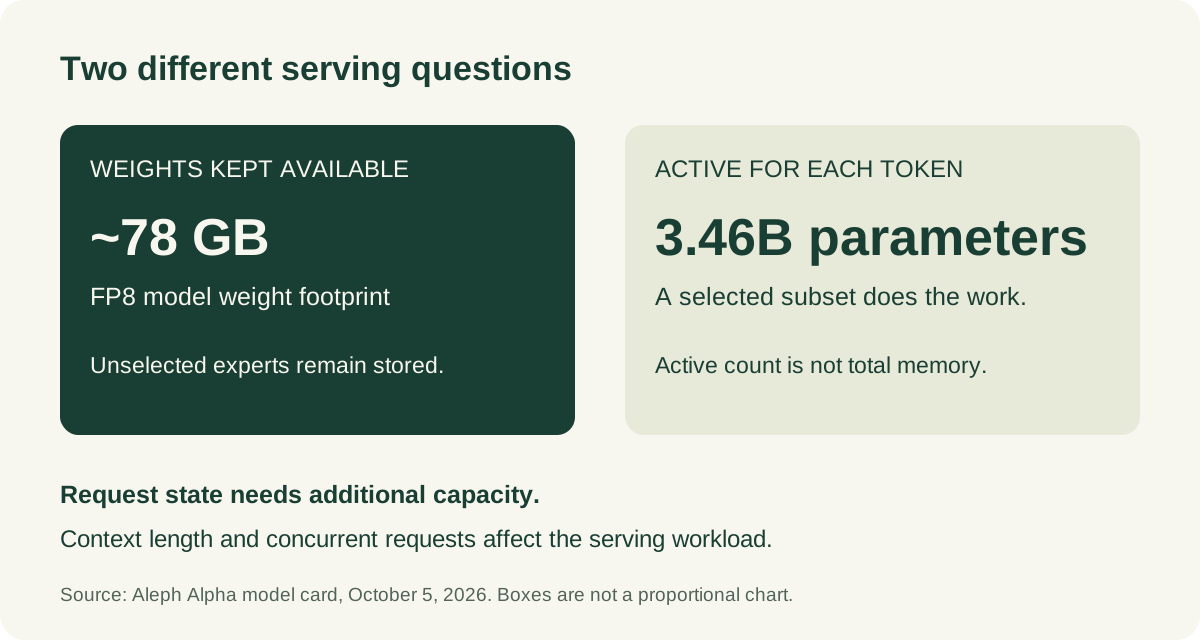
The number to pause over is the one that seems not to fit: 3.46 billion active parameters, but about 78 GB of FP8 weights. Both can be true. One describes the work selected for each token; the other describes model data that still has to fit somewhere. That distinction matters before anyone reserves a GPU or promises an interactive assistant.
Small active compute, a larger memory footprint
Kolibri is a mixture-of-experts model. Instead of using every expert for every token, it routes the token through a selected subset. That reduces the computation performed at that step. The experts that were not selected still need to be available for later tokens, so a low active count does not mean the rest of the model disappears from memory.
The published minimum configurations include one H200, B200 or B300, or two A100 80 GB or H100 SXM5 accelerators. Those configurations describe a documented deployment footprint. They do not tell an SRE how many simultaneous support investigations will meet the service's response-time target. Request length, generated output and concurrency remain part of that capacity question.
The context limit has a similar distinction. The card identifies 262,144 tokens as the native context and validates extended support up to 1,048,576. Aleph Alpha recommends staying at or below the native length for complex tasks and deployments sensitive to latency or throughput. The million-token ceiling offers an option; it is not the provider's default advice for every production request.
What the serving comparison establishes
Aleph Alpha's technical report compares quality and serving cost using synthetic prompts and high-concurrency decoding on a node with eight B200 accelerators. The post-trained throughput comparison uses a 16K context. It is evidence about that experiment, with each model assigned its fastest tested parallel layout, rather than a measurement of a one-GPU assistant responding to an engineer.
The support engineer waiting for an answer is not sitting inside the eight-GPU graph. Test the request lengths and simultaneous sessions that engineer will actually encounter, including the first requests after a cold restart. The published comparison can help choose what to examine. The AI storage and recovery analysis develops that connection between a tested configuration and the work it must serve. It cannot supply the missing observation from your one-GPU service.
Consider a hypothetical support assistant that searches German runbooks and English incident notes. A useful comparison would give Kolibri and the current model the same questions and source material, then check whether the answers cite the relevant passage, preserve its conditions and leave the engineer less correction work. Run that task at the expected number of simultaneous sessions and record completed answers alongside response time. These are proposed evaluation steps, not results from a Kolibri deployment.
If the workflow mainly needs other languages, or the available accelerator cannot hold the model and its request state, Kolibri's headline efficiency does not resolve the mismatch. A smaller model or a hosted service may be the more feasible comparison. For a bilingual workload that fits, the release creates a concrete option to test.
Integrating the release
Serving uses Aleph Alpha's vLLM plug-in package and its supported vLLM version, with Kolibri-specific reasoning and tool-call parsers. The release blog describes four reasoning settings, from none through high. Changing that setting changes the work requested from the model, so keep it recorded when comparing behavior.
The model card applies Apache 2.0 to the published weights and configuration files and excludes other artifacts from that grant. It also describes human-reviewed outputs and validated tool results as the intended integration. Self-hosting supplies control over where the model runs; the surrounding retrieval, review and execution workflow still determines what an operational assistant can safely do.
The bilingual support team has a clear finish line: find the German runbook passage, relate it correctly to the English incident notes and return while that answer is still useful. Kolibri’s language focus and self-hosting option make the experiment worth considering. Request size, simultaneous sessions and the corrections left for the engineer will decide whether it deserves a place in the service.
Sources & context
Sources linked in this article. Read alongside the author’s analysis; a citation does not independently verify a publisher’s claims.
- October 5 product announcementaleph-alpha.com
- model cardhuggingface.co
- technical reportaleph-alpha.com
- release blogaleph-alpha.com