

On this page2 sections
NVIDIA’s NodeWright coordinates package, configuration and tuning changes across Kubernetes hosts while accounting for the workloads using them. The September 23 announcement introduced the open-source operator, previously used internally as Skyhook, for maintenance of GPU fleets. Its rollout controls let a team work through selected nodes instead of treating every host change as an independent manual procedure.
The team declares a desired change in a Kubernetes custom resource. NodeWright watches it and executes containerized packages containing host-changing scripts and files. NVIDIA describes progressive updates, interruption controls and package verification that can stop a rollout. These make the process observable; the team still has to determine which machines may change and what result is acceptable.
A node label defines the first rollout
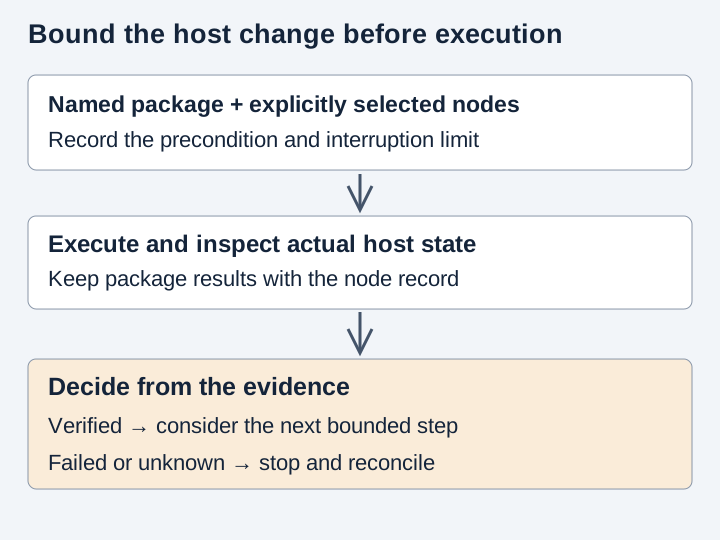
The package and its selected nodes describe one change together: a kernel setting intended for one worker becomes a fleet-wide update if the selector matches every node. This applies the bounded-action guidance to a deterministic controller as well as to an agent. The mechanism can reliably perform the described change while the description itself targets too much.
The official quickstart starts deliberately with a label on one node. An empty selector matches all nodes, so copying a resource without inspecting selection materially changes the action. The guide also recommends pinning the chart version for a real deployment, keeping the controller configuration identifiable beside the update package.
Teams migrating from Skyhook also need to check API compatibility. The CLI reference says the current CLI requires nodewright.nvidia.com and cannot use an operator serving only the legacy group. A renamed command is not automatically a drop-in client for the installed operator.
When the package runs but verification loses contact
Consider a hypothetical one-node pilot changing a GPU worker’s kernel setting. The package runs, then the verification job loses contact before reporting. The setting may already be in place. Inspect current host state and the package execution record before retrying, so another run does not repeat an unknown effect. Keeping the trial on one labeled node makes that uncertainty manageable before the rollout grows.
For an irreversible host change, a small rollout still needs an approved recovery or replacement plan; scope alone does not create an undo. Inference workers also need enough service capacity during the allowed interruption, a separate question covered by the disruption-budget pilot. An available update mechanism cannot establish that the fleet can afford maintenance now.
The one-node result provides the information needed for the next rollout step: the intended host setting, the package’s execution record and the workload’s behavior afterward. If verification loses contact, keeping the uncertainty on that node makes it possible to resolve the result without spreading the same unexplained change across the fleet.
Sources & context
Sources linked in this article. Read alongside the author’s analysis; a citation does not independently verify a publisher’s claims.
- announcementdeveloper.nvidia.com
- official quickstartdocs.nvidia.com
- CLI referencedocs.nvidia.com