

On this page2 sections
NVIDIA reports a video workload falling from about 156.6 seconds on one GPU to 34.2 seconds on eight. That is an appealing reduction in a person’s wait. A service operator has another question beside it: what happens to the next request while all eight devices are working on this one? TensorRT’s multi-device demonstration makes the difference between single-request speed and service capacity concrete.
The figures come from NVIDIA’s September 21 technical report on serving a distributed TensorRT model through one Dynamo-Triton endpoint, using Cosmos 3 Nano video generation. They are vendor measurements for that specified workload, not an AIOpsSRE test or a general speedup promise for models assigned more GPUs.
The feature is already documented in the 26.07 release notes. September 21 dates the demonstration’s publication, not the container release. The report supplies an example of the capability rather than announcing that container for the first time.
One endpoint can coordinate several devices
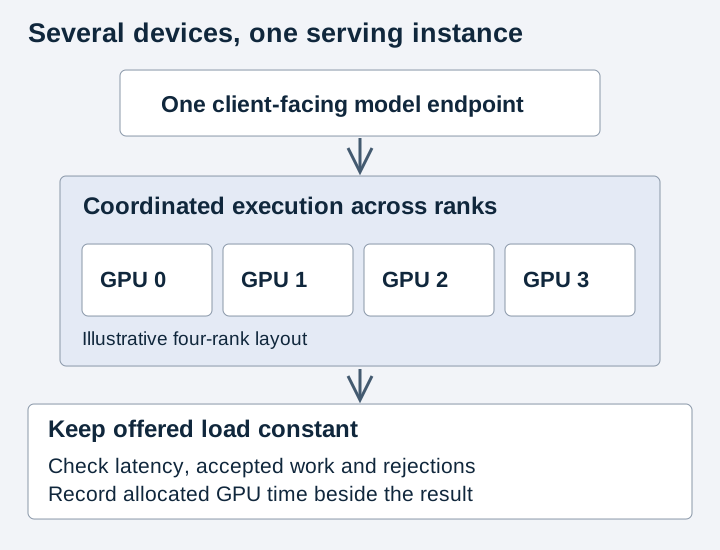
The backend documentation describes a model instance coordinating multiple GPUs through TensorRT and NCCL collectives. Its engine must already support distributed execution. Merely changing serving configuration does not partition an arbitrary single-device model into a functioning distributed engine.
That keeps the client interface convenient while giving operators a coordinated device path to inspect. A stalled request may be waiting on work across several GPUs. Model-instance configuration and device-level evidence are needed to explain that wait, even when the client sees only one endpoint.
Single-request speed and a busy service
Before describing extra GPUs as a capacity improvement, compare latency, accepted completions and rejections under the same offered workload. The Linux performance guidance supplies this experiment rule: a quicker result is incomplete evidence if the comparison also changes how much work reaches the system.
The reported timing measures complete generation after warmup, excluding model loading and video encoding. It does not establish concurrent-request throughput or cost per video. Those boundaries tell the local trial what still needs measurement: the work and waiting included in the service’s actual completion target.
Consider a hypothetical service with eight GPUs. Allocating all of them to one request may finish that request sooner while other arrivals wait. Compare supported alternatives with the same arrival pattern, output requirements and acceptance criteria, recording resources used. Eight independent replicas are a valid comparison only if the model fits and that arrangement is supported.
Over a fixed observation period, count accepted outputs and rejections, then measure waiting and reserved device time. Apply normal output-quality checks before treating a generated video as completed useful work. The comparison can then show whether faster individual generation also changes the amount of acceptable work the service finishes.
When the model cannot fit on one device, compare feasible distributed arrangements against the service target; a single-GPU baseline cannot decide deployment. When it can fit, reserving eight devices may still be worthwhile if one video must finish sooner and the shorter wait justifies the cost. Where many requests compete for that pool, compare waiting and completed videos under the same arriving work before choosing the layout. The reported speedup then informs the service tradeoff without answering it on its own.
Sources & context
Sources linked in this article. Read alongside the author’s analysis; a citation does not independently verify a publisher’s claims.
- September 21 technical reportdeveloper.nvidia.com
- 26.07 release notesdocs.nvidia.com
- backend documentationdocs.nvidia.com