

On this page3 sections
A read-only incident assistant can still make a struggling database work harder. Its queries do not change rows, but they consume resources while the application is trying to serve users. Google’s AlloyDB preview addresses the query-processing part of that conflict by giving agent investigations separate compute.
In the September 25 announcement, Google describes serverless, read-only PostgreSQL compute for agents that scales to zero when idle and accesses fresh data separately from primary, standby and read-pool compute. For incident work, those two properties create a useful tradeoff to test: isolation of query processing and readiness when a quiet assistant suddenly needs answers.
Separate processors still read shared storage
Agent queries execute on their own compute while accessing AlloyDB’s shared Colossus storage. The primary no longer has to provide that query-processing capacity. Storage remains shared, however, so a local trial still needs to observe how the application and investigation behave together rather than assuming separation has removed every interaction.
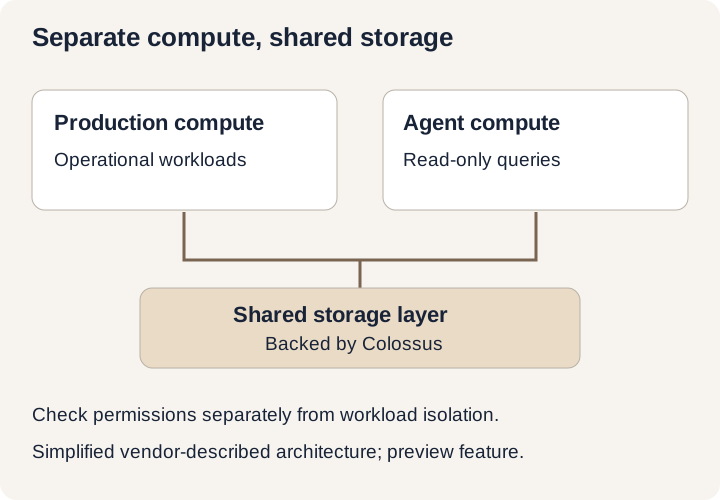
Access is another independent choice. An investigation requiring deployment metadata does not automatically justify reading customer records. Confirm permissions, supported configurations and pricing in the preview documentation for the intended environment. Neither the architecture nor the announcement establishes the appropriate data scope or eventual bill.
The first investigation after a quiet night
Consider a hypothetical assistant that sits unused overnight, then queries inventory and recent job records during a failed deployment. The first investigation includes whatever work is required to become ready after that idle period. A demonstration on already-warm compute leaves that part of the responder’s wait unmeasured.
Compare the same burst of queries after idle time and on warm compute before adopting the preview for incidents. Use sanitized examples resembling the actual investigation, including an expensive query the assistant could plausibly request. Run representative application traffic alongside it in staging so the trial has an explicit workload to protect.
Measure the complete investigation time together with application latency and errors. Include connection setup and failed requests, since they contribute to the person’s wait even when individual successful queries are quick. The result should reveal whether moving compute helped the overall investigation rather than just one timed SQL statement.
The AI storage evaluation article uses the same principle: evaluate the access pattern and cold recovery that the intended job will encounter. Here, the useful outcome is an investigation completed sooner without worsening the application’s operating result.
Read-only investigations and the existing fallback
If the next step must update rows or apply a repair, this read-only capability cannot perform it. Keep that change in the separately authorized workflow. For the investigation pilot, limit concurrency, retain query logs and preserve the current route for responders if the preview is unavailable or slow.
The idle and warm runs give the incident team a concrete comparison: how long the responder waits for an investigation, and how application requests behave alongside it. Separate compute is useful when it improves that combination enough to justify its cost. Keeping the existing investigation route available also lets responders continue when the preview cannot supply an answer in time.
Sources & context
Sources linked in this article. Read alongside the author’s analysis; a citation does not independently verify a publisher’s claims.
- AlloyDB agent-compute announcement (September 25, 2026)cloud.google.com
- public documentationdocs.cloud.google.com