
On this page3 sections
GPT-6 Sol and Luna give an incident-summary service two ways to reduce model spending: lower token rates and cheaper reuse of a repeated prompt prefix. The first cache write carries a premium, so the number of later matching requests matters. The calculation below shows what that repeated prefix costs before considering the work needed to produce an accepted summary.
OpenAI announced the models on September 22 alongside prompt-caching changes. The API identifiers are gpt-6-sol and gpt-6-luna; the announcement also describes a gradual rollout in ChatGPT Work and Codex. For a team already using model-generated summaries, comparing the same cases should include revisions that restore omitted evidence, the accounting question developed in our agent observability analysis.
What each rate buys
The standard prices below are in dollars per million tokens, checked September 22. The model pages for Sol and Luna distinguish ordinary input from cache writes and reads, while output has its own charge. Those categories matter because a repeated prompt and a newly generated summary do different kinds of work.
| Model | Input | Cache write | Cache read | Output |
|---|---|---|---|---|
| GPT-6 Sol | $2.00 | $2.50 | $0.20 | $10.00 |
| GPT-6 Luna | $0.10 | $0.125 | $0.01 | $0.50 |
These standard rates are a starting point for calculation, not a quote for every request. Both pages document higher rates above 272,000 input tokens, regional premiums and processing-tier differences. Tool charges can also contribute. A comparison should use the rate that applies to its actual workload rather than multiply all observed tokens by the most attractive cell.
Why a more expensive write can still save money
OpenAI’s caching documentation describes reuse of computation for a matching prompt prefix. A cache write costs 1.25 times ordinary input, and a read costs 0.1 times. Explicit breakpoints mark the end of reusable material. The initial premium can be repaid by subsequent reuse, while changing input and newly generated output remain work the request must perform.
An illustrative 10,000-token Sol prefix makes the tradeoff inspectable. Ordinary input costs $0.02, a cache write $0.025, and a complete read $0.002. One write followed by nine full reads therefore costs $0.043 for the prefix, compared with $0.20 for ten ordinary input charges. The attractive result depends on those nine reads actually matching the full prefix. It excludes changing input, output, tools and failed attempts, so it should not be presented as the price of ten completed tasks.
Correction work can consume the token saving
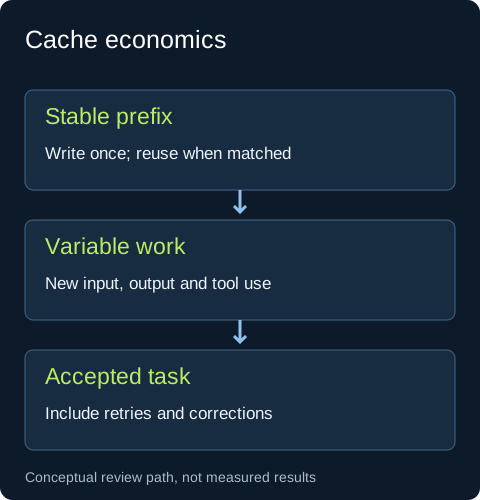
In a hypothetical incident-summary pilot, two models receive the same evidence bundle, but one repeatedly omits an unresolved dependency. Its provider charge is lower. The reviewer then has to rediscover the dependency, repair the summary and check the revised update. The prefix saving can be real at the same time as the workflow creates extra work downstream.
Following task identities through every attempt makes that effect visible. For each case, retain the model, cached and uncached usage, output usage, retries, acceptance result and correction minutes. Include both repeated-context cases and genuinely new evidence so the trial does not promise reuse that ordinary operation cannot deliver. The approval and service-verification criteria from the incident-agent evaluation guide should stay fixed while the model changes.
Total provider spending divided by accepted tasks gives an interpretable monetary measure, provided the acceptance count is shown beside it. With no accepted tasks, there is no cost-per-success value to report. Correction time answers another important question and should remain visible separately, rather than disappearing into a token calculation that has no labor-cost assumption.
Exploratory work without a fixed acceptance test needs a comparison of useful findings and reviewer effort instead of a forced binary success score. The incident-summary case is more bounded: the reviewer can say whether the update preserves the evidence needed for handoff. That makes it possible to inspect why a cheaper candidate passed or failed.
The migration choice is then more informative than “Luna is cheaper” or “the cache hit.” A configuration earns its place when its usage records explain the lower spending and its accepted summaries show that the team still receives the work it wanted. If repair grows, the same trial identifies where the apparent saving went.
Sources & context
Sources linked in this article. Read alongside the author’s analysis; a citation does not independently verify a publisher’s claims.
- announcementopenai.com
- Soldevelopers.openai.com
- Lunadevelopers.openai.com
- OpenAI’s caching documentationdevelopers.openai.com